Trusted VS Factory Agent · 1:1 Super Clone Watches


I’m writing this review because one of my good customers wants to buy this watch. It hadn’t shipped yet, so I took a full day and put it through everything. I’m sure my numbers aren’t perfectly precise, but I hope they help everyone out there who loves the Vacheron Constantin 222.
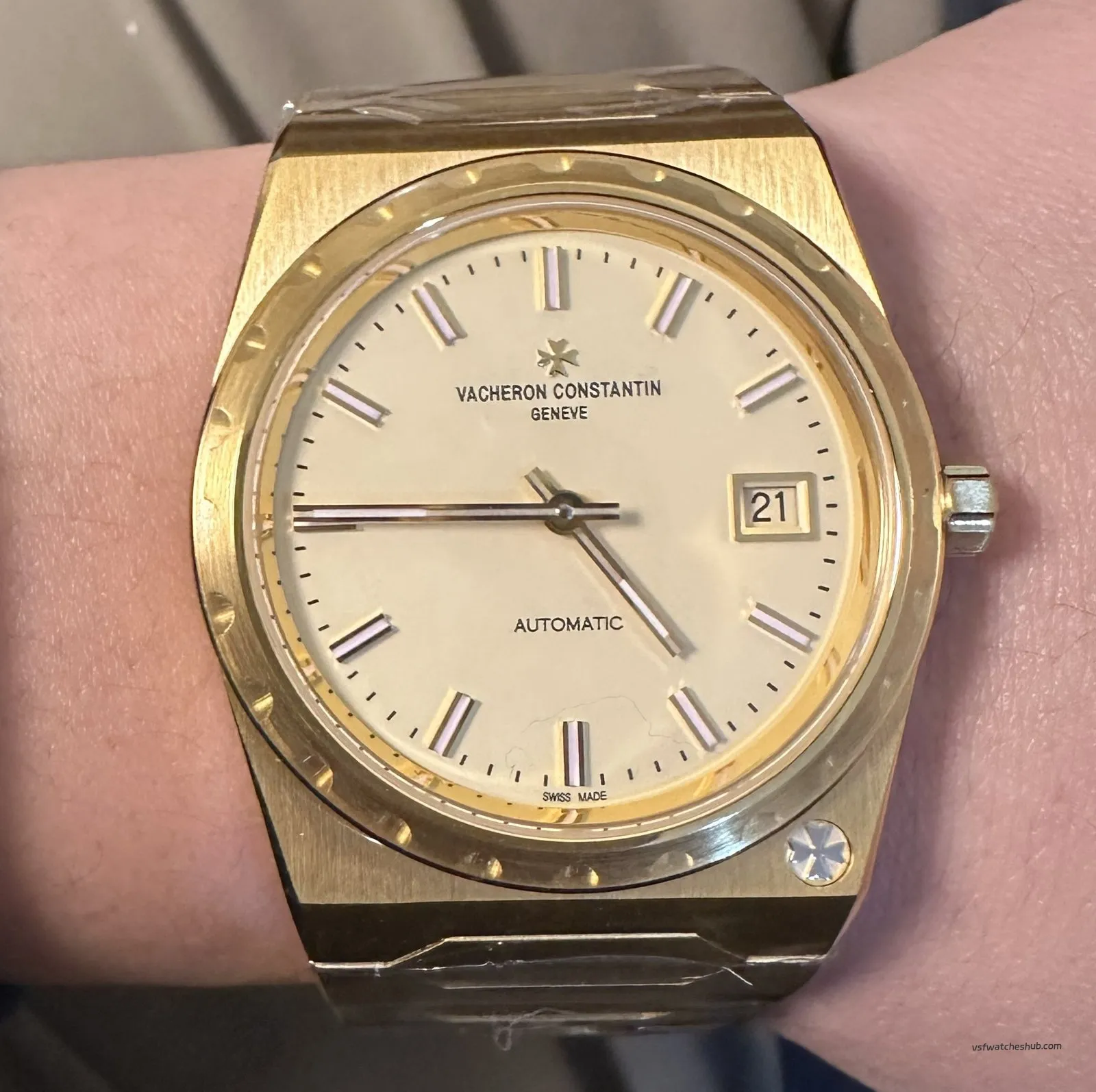
Short version: this is the PPF Factory 222 in yellow gold, and on dial, bezel and bracelet design it’s the closest gold 222 I’ve had on my desk. The thing that gives it away is weight. At 123 grams it’s gold-plated steel, not solid 18k gold. It’s also about 0.5 mm thicker than the real 4200H/222J-B935, which you’d only spot with the two side by side.
If you can live with the weight, it’s a lot of watch for well under $1,000. If it bothers you, read the weight section before you order.
Everything below comes from my own bench: caliper readings, a scale, a dial-up timegrapher reading and a try-on. Where I compare against the genuine, I’m using Vacheron Constantin’s published specs. Where they don’t publish a number, I say so instead of guessing.
Why PPF, and why I stopped recommending MKS
Quite a few factories make the 222 re-edition, and a lot of them aren’t reliable. I found that out the hard way. I once recommended the MKS version of this watch to customers. Two watches went out and both had problems. On one, the small Maltese cross emblem at the lower right of the case fell off. The other developed a movement fault. Two problems out of two watches is not a failure rate I’ll accept from anything I sell.
So my advice is simple: never buy the MKS 222. The watch in this review is from PPF, and every number below was measured on it.
Our measurements next to the official spec
| Measurement | This watch | Genuine 4200H/222J-B935 |
|---|---|---|
| Case diameter | 37.25 mm | 37 mm |
| Case thickness | About 8.45 mm (9.13 mm through the protective film) | 7.95 mm |
| Lug to lug | 43.3 mm | Not published |
| Bracelet width at the case | 28.0 mm | Not published |
| Weight, full uncut bracelet | 123 g | Not published |
| Bracelet links | 18 | Not published |
| Clasp thickness | 5.29 mm | Not published |
| Beat rate | 28,800 vph | 28,800 vph (Cal. 2455/2) |
| Rate, dial up | +3 s/day | n/a |
| Amplitude / beat error, dial up | 265° / 0.1 ms | n/a |
| Power reserve | Not measured yet | 40 hours |
| Water resistance | Not tested. Keep it out of the water | 50 m |
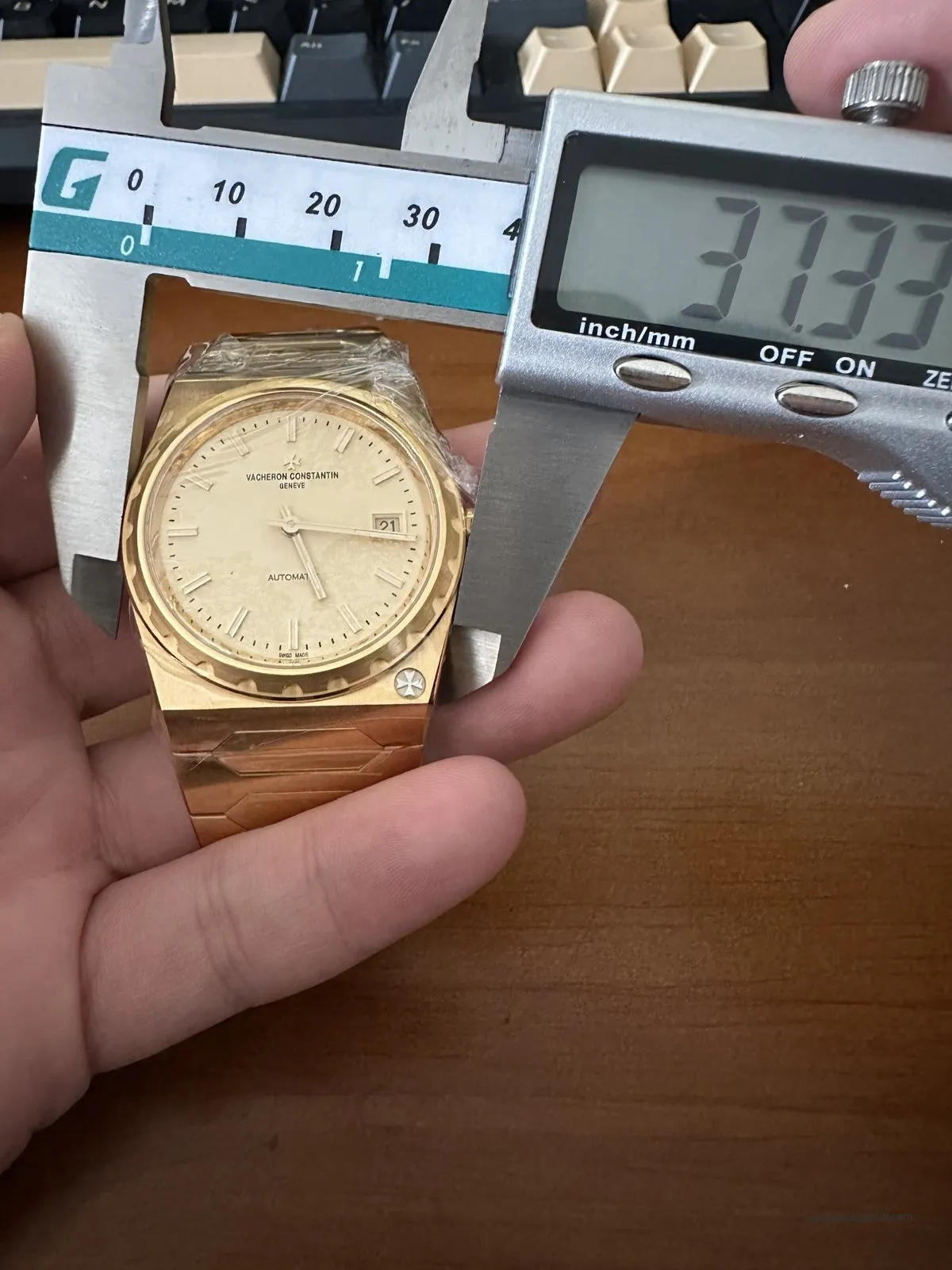
Diameter is basically on the money. A quarter of a millimetre is about what you’d get between two different calipers.
Thickness: closer than the caliper photo suggests
The caliper in the photo reads 9.13 mm, but that reading was taken over the protective film. I left the film on so a metal caliper wouldn’t scratch the case. Without the film, the difference from the genuine’s 7.95 mm comes down to about 0.5 mm, so roughly 8.45 mm. On a watch whose whole personality is being flat and integrated, that’s still worth knowing, but it’s a small gap.
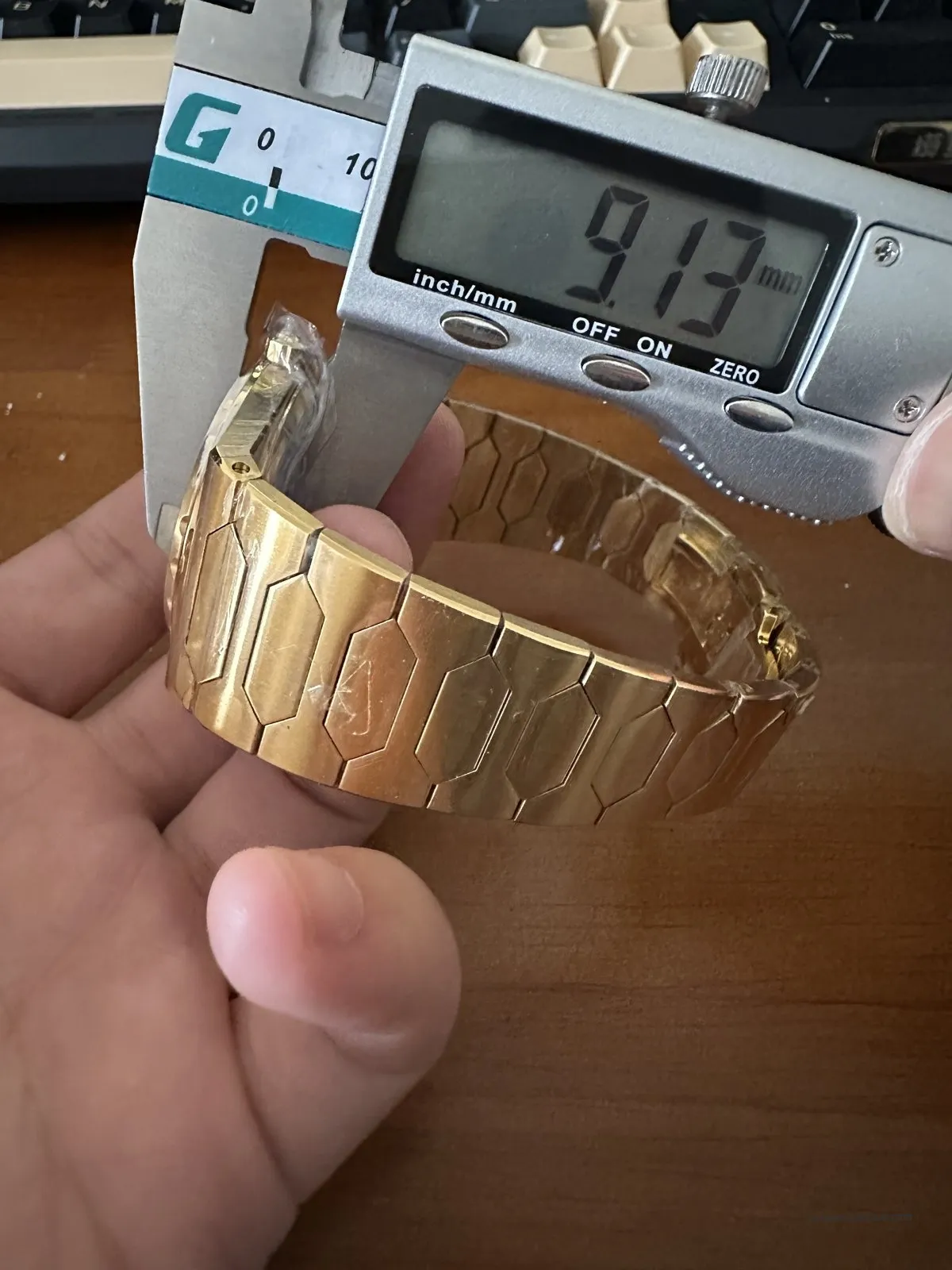
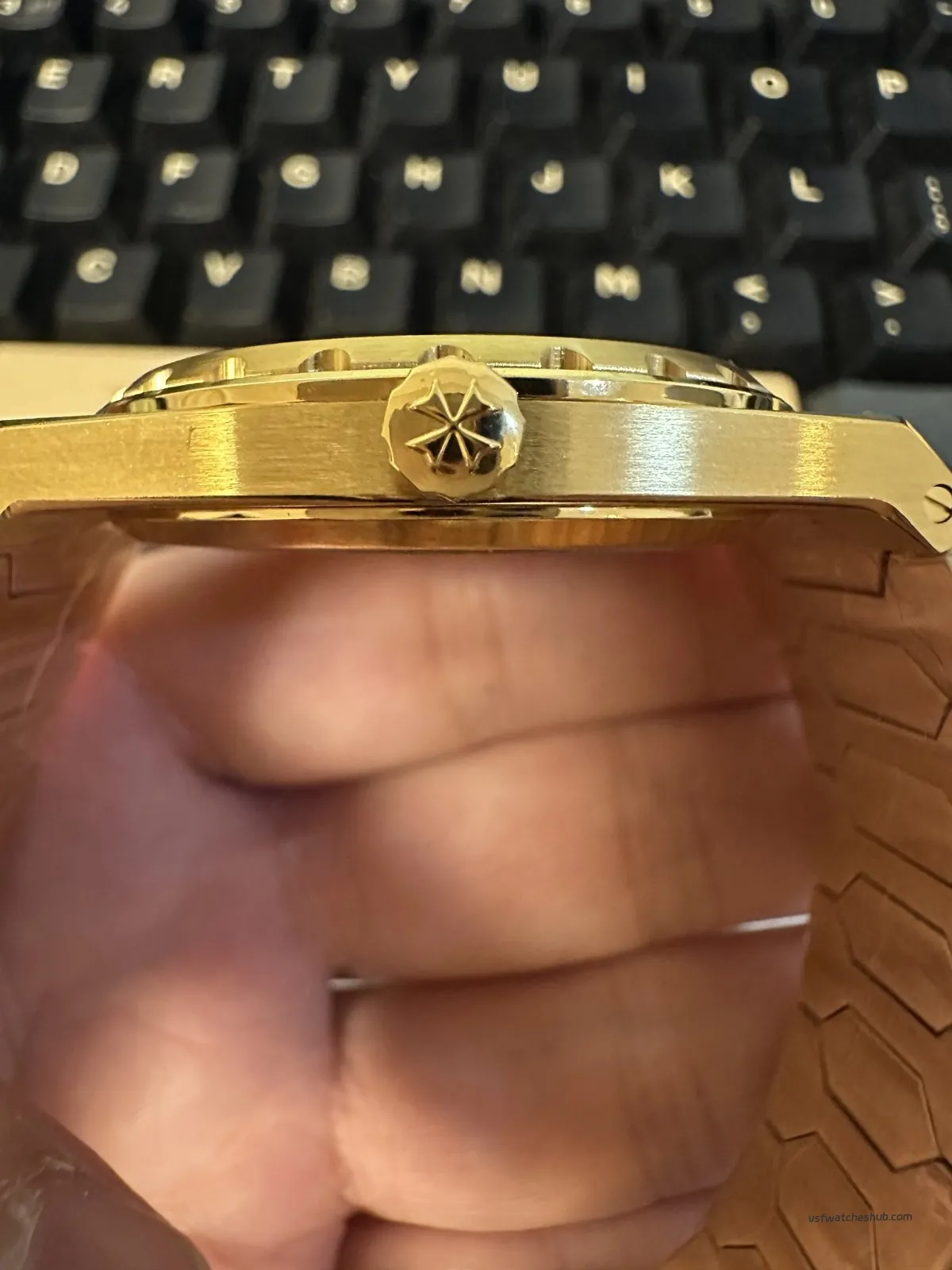
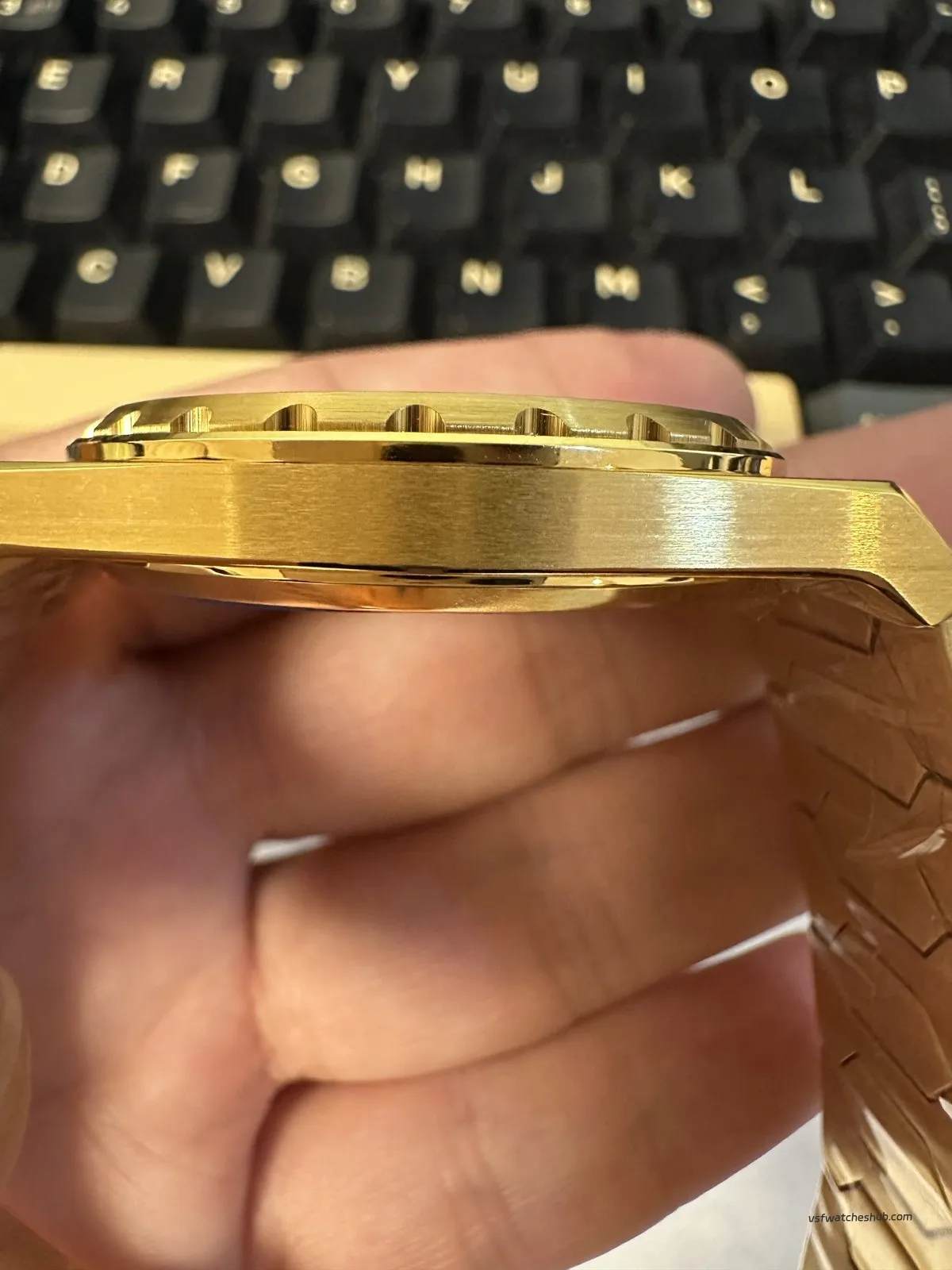
Can you see it on the wrist? From the top, no. From the side the case sits a little taller than in the official photos, but you need the two next to each other to notice.
Weight: 123 grams of plated steel
The case and bracelet here are steel with gold-tone plating. The genuine is solid 18k 3N yellow gold, and 18k gold is roughly twice as dense as steel, so the real one is going to feel clearly heavier in the hand. Vacheron doesn’t publish a weight, so I’m not going to throw a number at you.
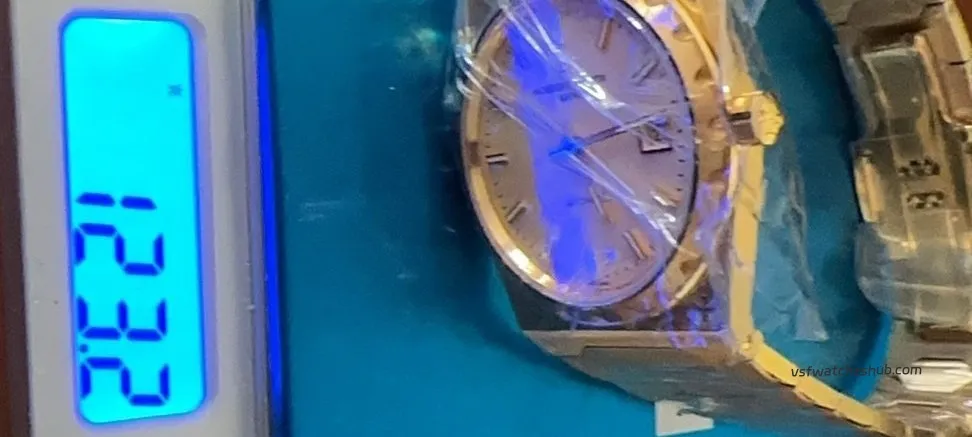
On its own, 123 g doesn’t feel cheap. I expected something closer to 110 g for a watch this thin, and it doesn’t feel floaty on the wrist. Put it in one hand and a genuine in the other though, and you’d know straight away. If that heft matters to you, look at the steel 222 with the blue dial instead, where the weight question doesn’t come up.
One more thing about plating. The color matched the genuine 3N gold in every photo I compared it to, and in daylight it looks right. But it is plating. Scrape it hard against a wall and you may see steel underneath. I haven’t worn it long term, so I can’t tell you how the color holds up over a year and I won’t promise anything there.
Dial and hands
I went over the dial under a loupe looking for crooked print, dust or glue and couldn’t find any. The Maltese cross, the VACHERON CONSTANTIN GENEVE print and AUTOMATIC all line up cleanly, and the dial texture reads the same as the official shots.
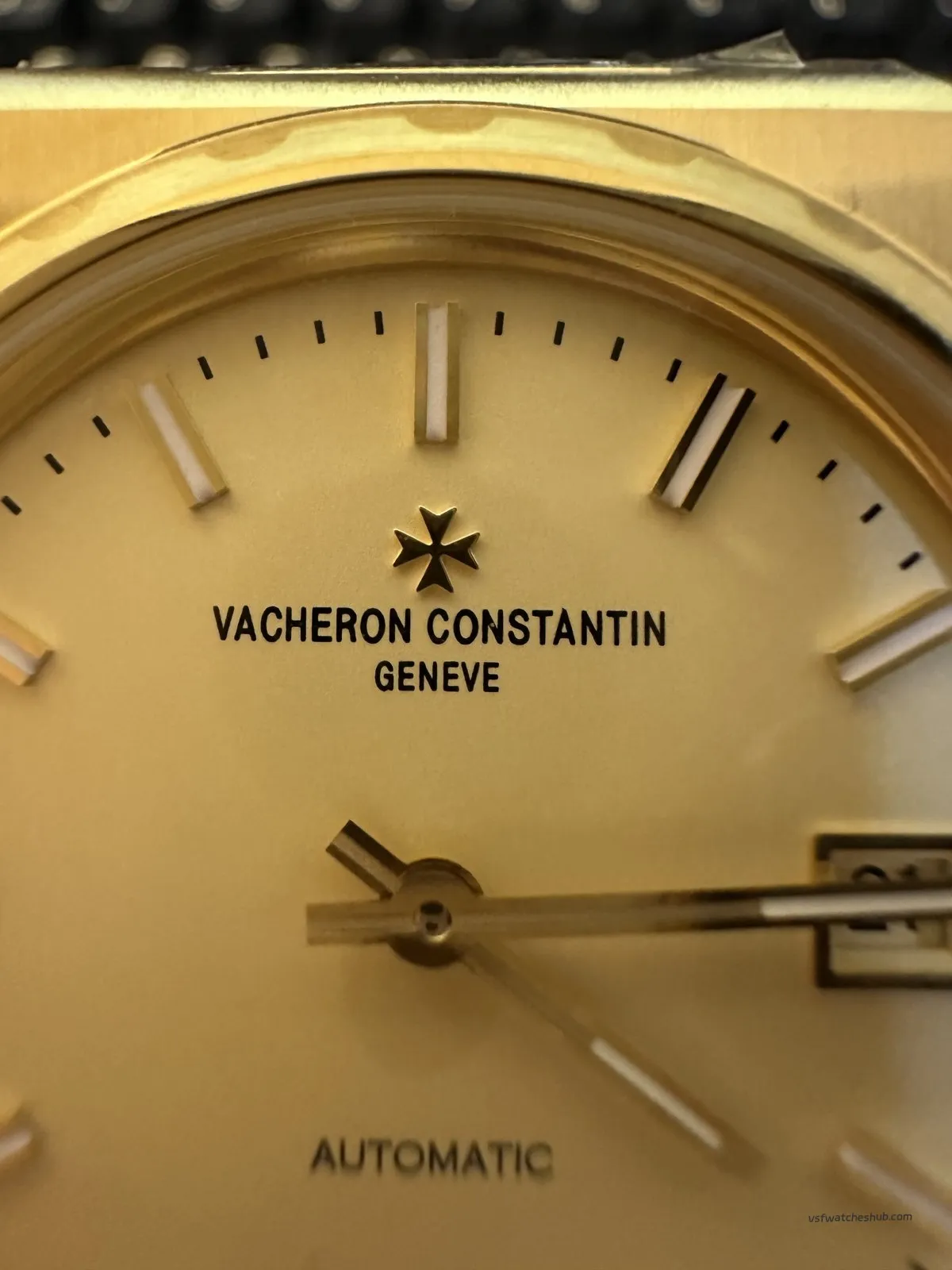
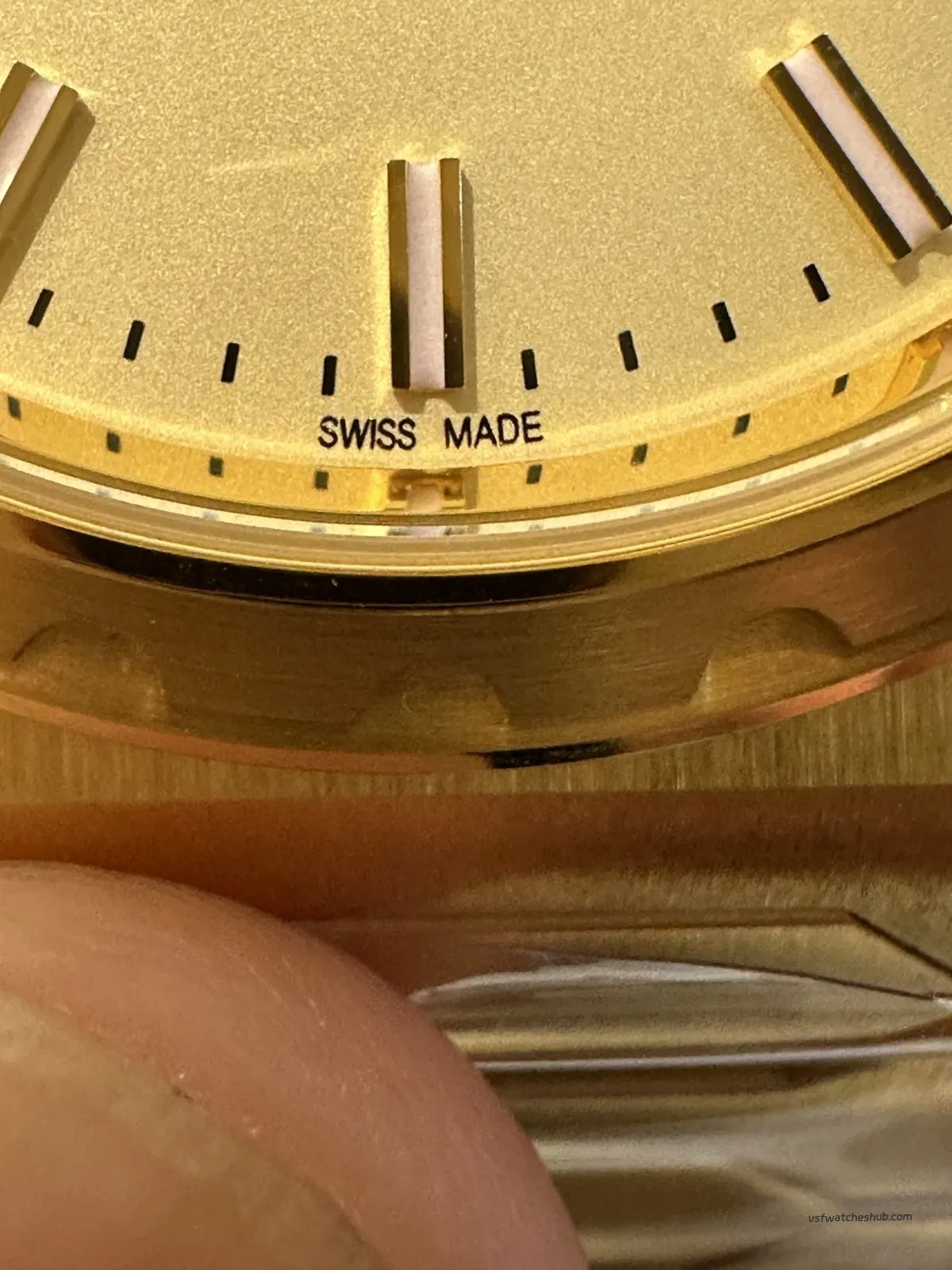
Up close the logo print has clean edges and even ink, and the small Maltese cross above it is crisp. Down at 6 o’clock the SWISS MADE line is tiny but still sharp.
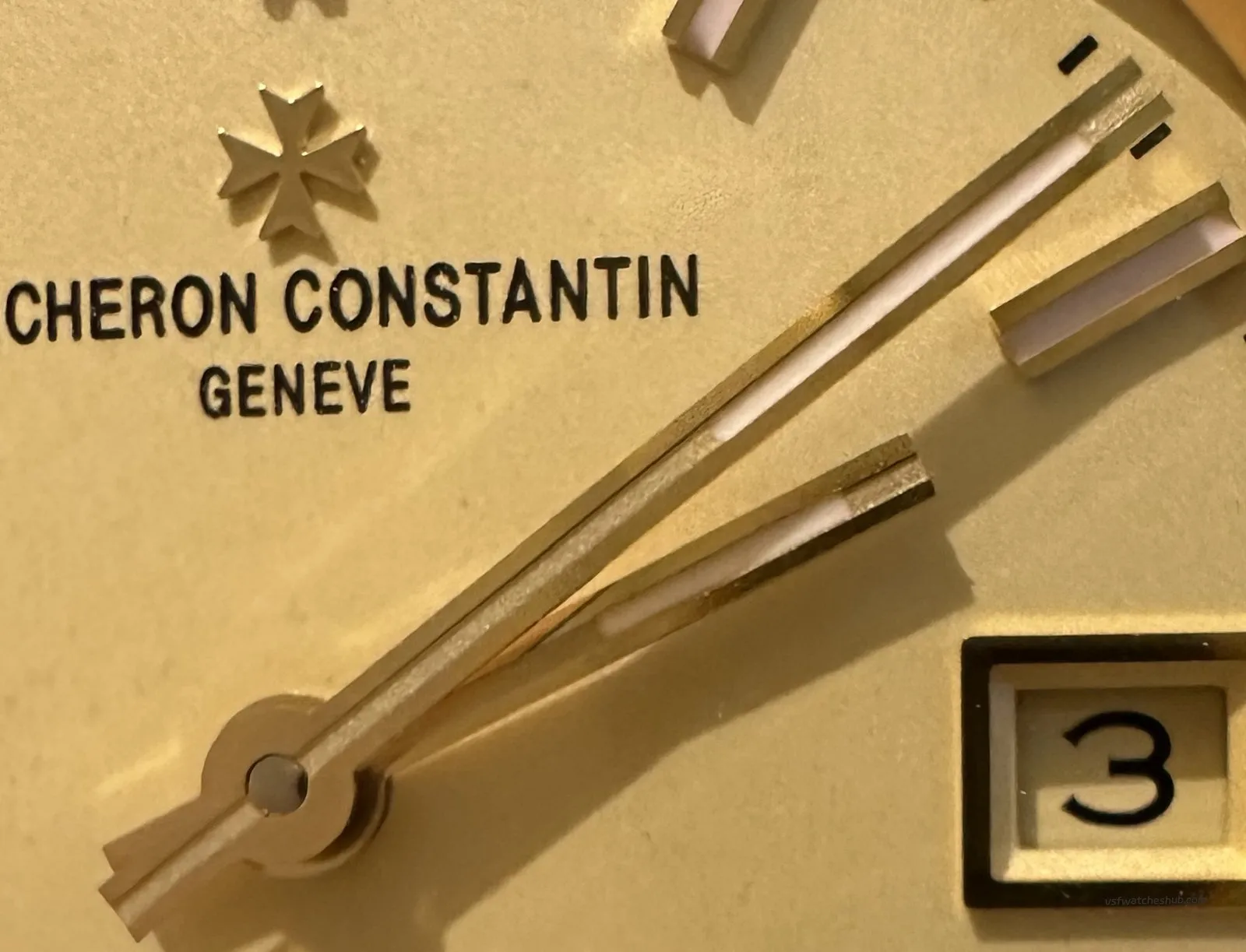
The hands match the genuine in length and shape as far as I could tell from reference photos. Blow the macro up a few times and the lume fill along the hands isn’t perfectly even. At normal viewing distance you can’t see it, and we can’t say whether the genuine looks any different that close.
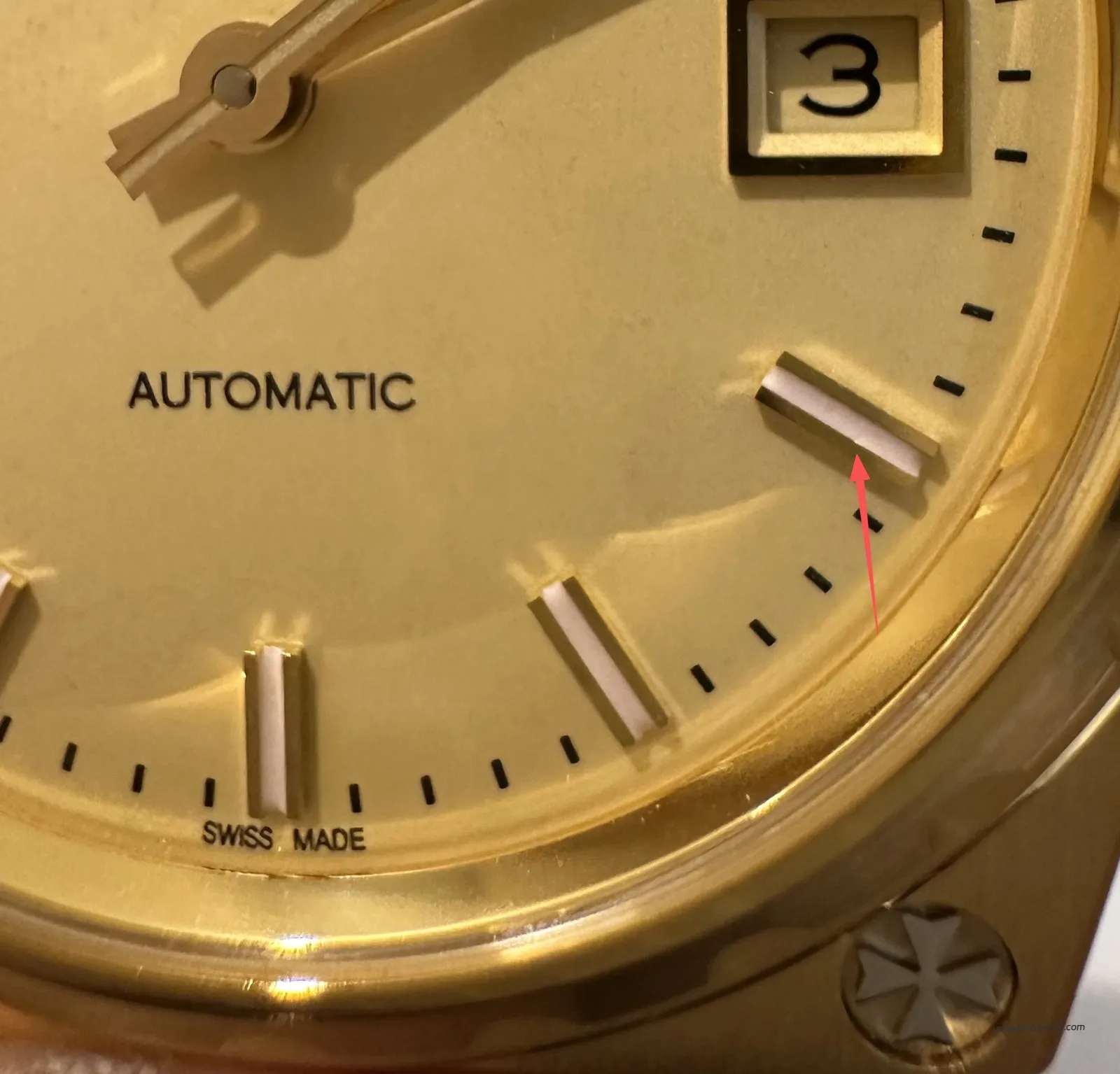
Same story on one baton index: at macro level there’s a tiny mark in the lume fill, arrowed above. It’s the only flaw I found on the dial and it’s invisible without a loupe.
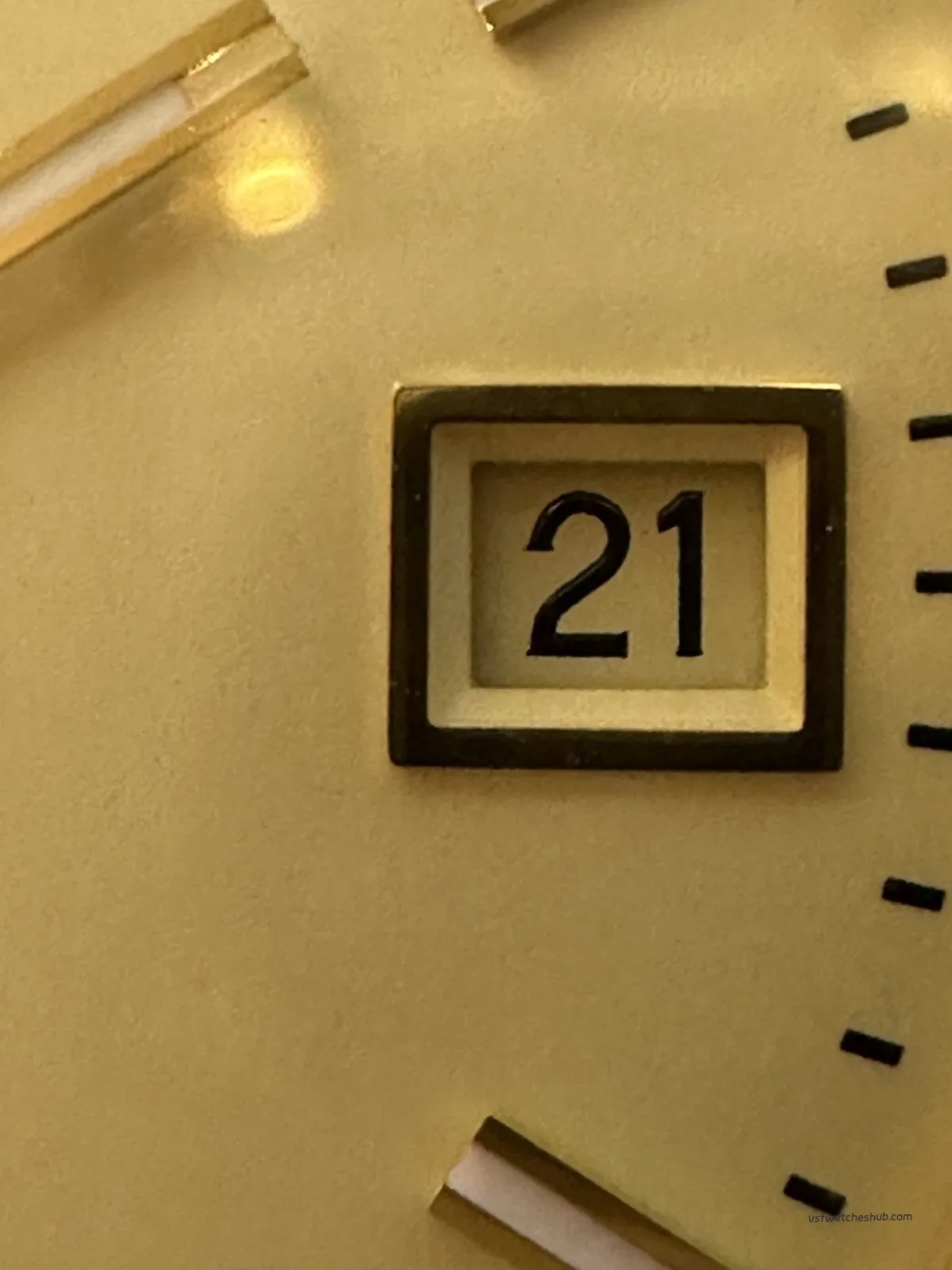
The framed date window is crisp. At 5x you can find small imperfections in the printed numerals. For print this small I’d call that normal, and without a genuine under the same magnification we can’t call it a difference.
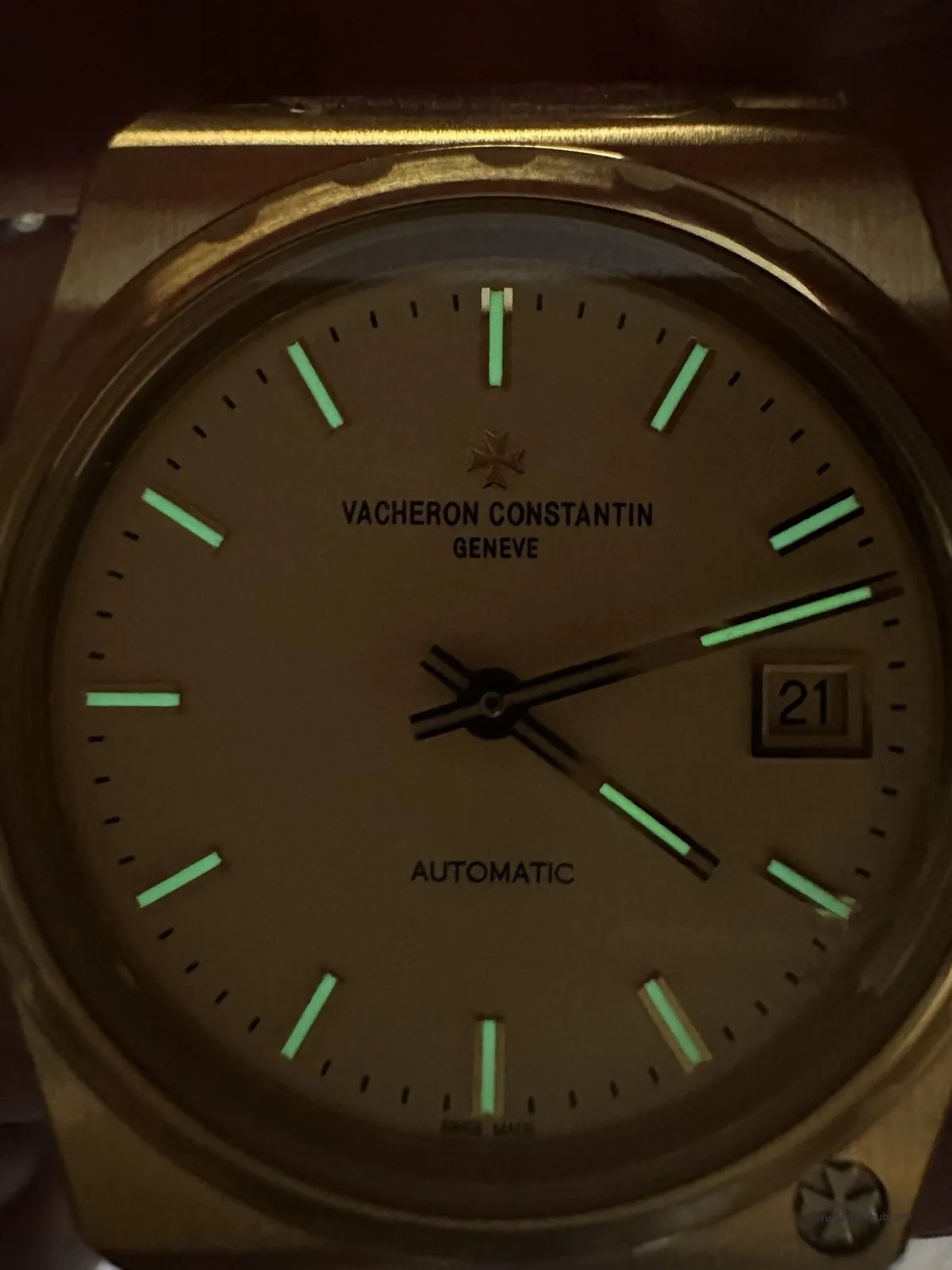
Lume is green on both hands and indices.
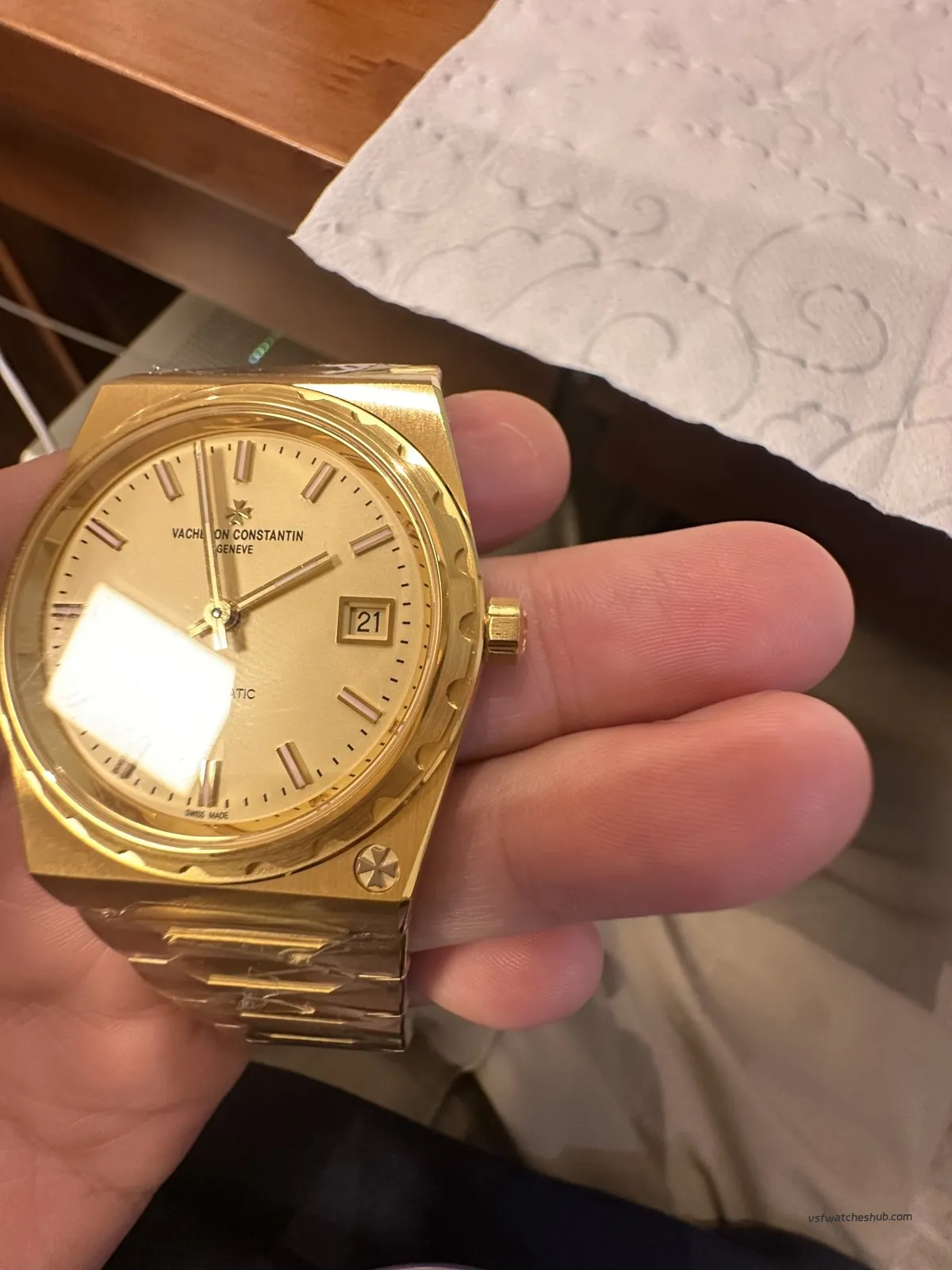
One more thing you’ll notice in photos: under a direct light the crystal throws back a bright white reflection, so in strong sun the dial can wash out at certain angles.
Bezel and case finishing
The bezel is fixed, and the notches are where this watch impressed me most. The edges are cleanly cut and you can even see brushing inside them. I compared notch length and width against genuine photos and couldn’t find a difference by eye.
The case flanks are brushed. Next to the genuine, the brushing is a touch softer and less pronounced. Nothing is wrong with it, it just doesn’t pop under light the way the real one does.
Crown and setting
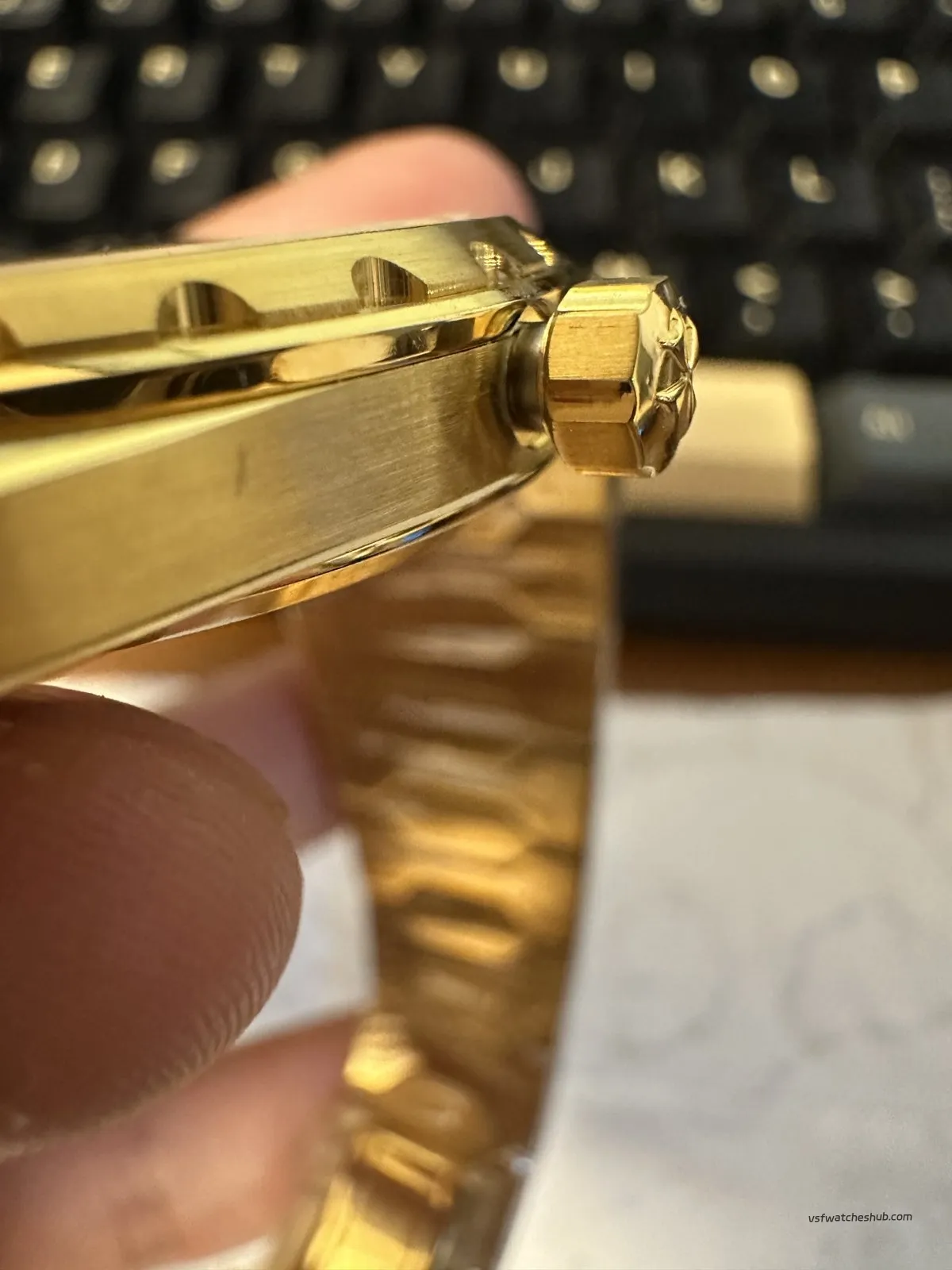
This is the weakest part for me. The crown works, threads cleanly and doesn’t slip, but it doesn’t have that precious-metal feel. It feels like a normal crown. The Maltese cross on the end of the crown is cleanly cut, though, so it looks the part.
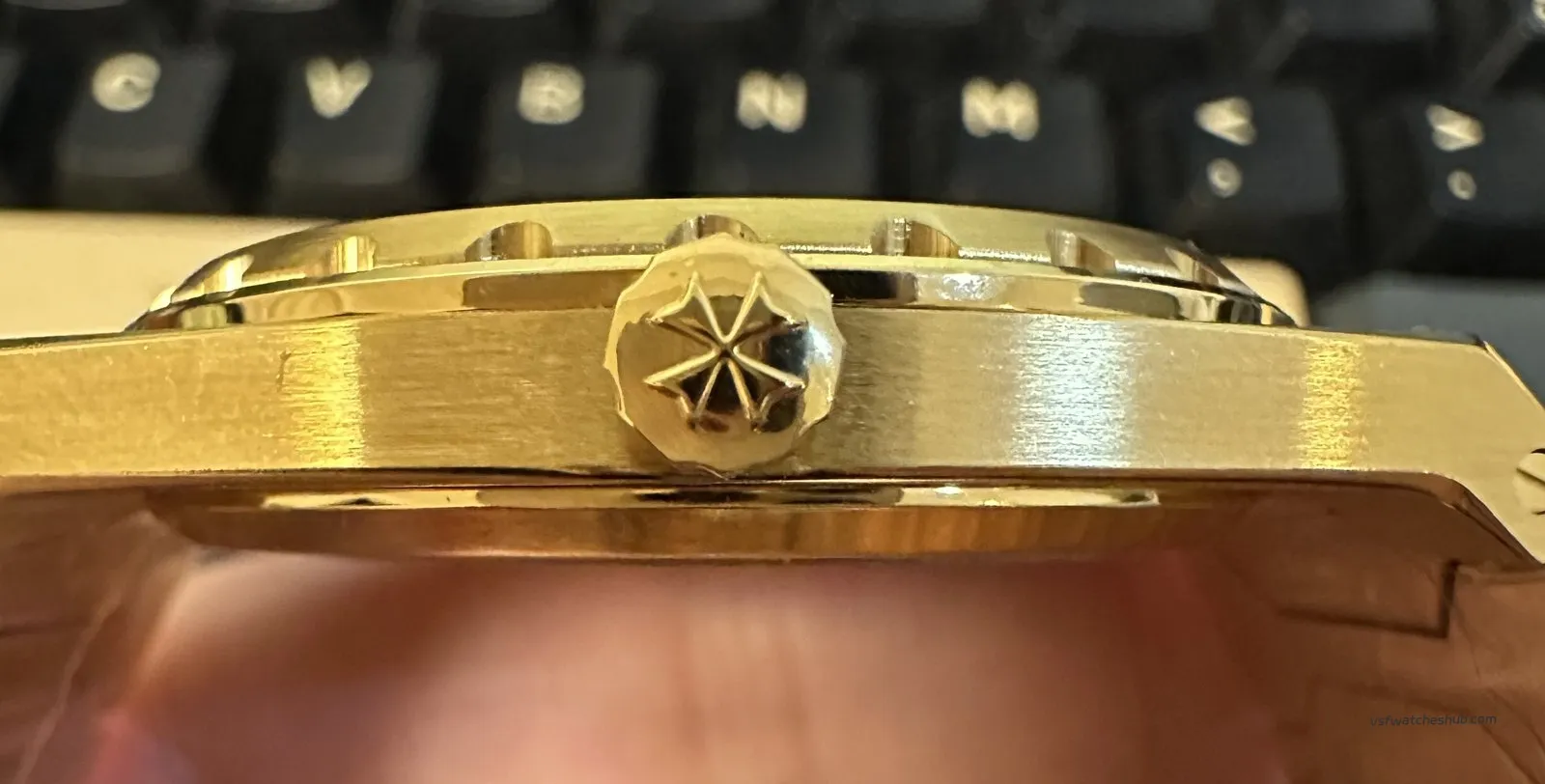
Practical tip: pull it out gently. It’s easy to go straight past the first position into the second. Once you know that, setting the date and time is smooth.
Here’s the crown in use: winding, setting the time and changing the date.
Water is the other thing to know about this crown. I couldn’t test water resistance, and a crown like this can’t give you a proper seal. In daily wear, avoid getting it soaked as much as you can. Swimming with it is out of the question.
Bracelet and clasp
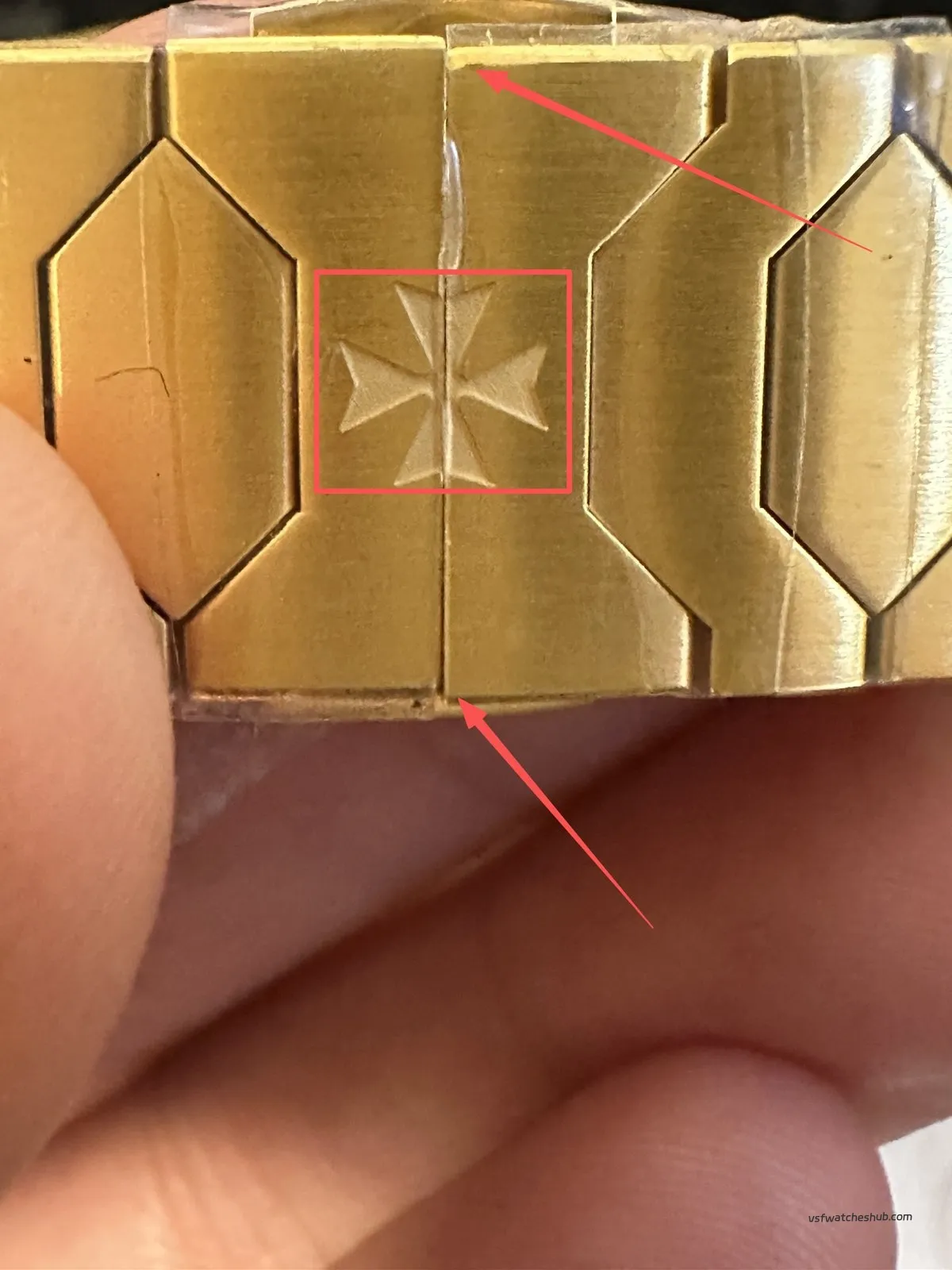
The hexagonal links and the Maltese cross on the clasp cover look right. Mine still has the protective film on, which is why there’s no screw close-up. I couldn’t focus through the film, and it’s also why this is a bench review plus a try-on rather than a long-term wear test.
Two small notes. The clasp was stiff to open a few times, which I see on plenty of new bracelets, and it loosens up with use. And if you look closely at the edges of the clasp cover, the two halves don’t sit perfectly flush (arrowed). No pinching, nothing sharp against the skin.
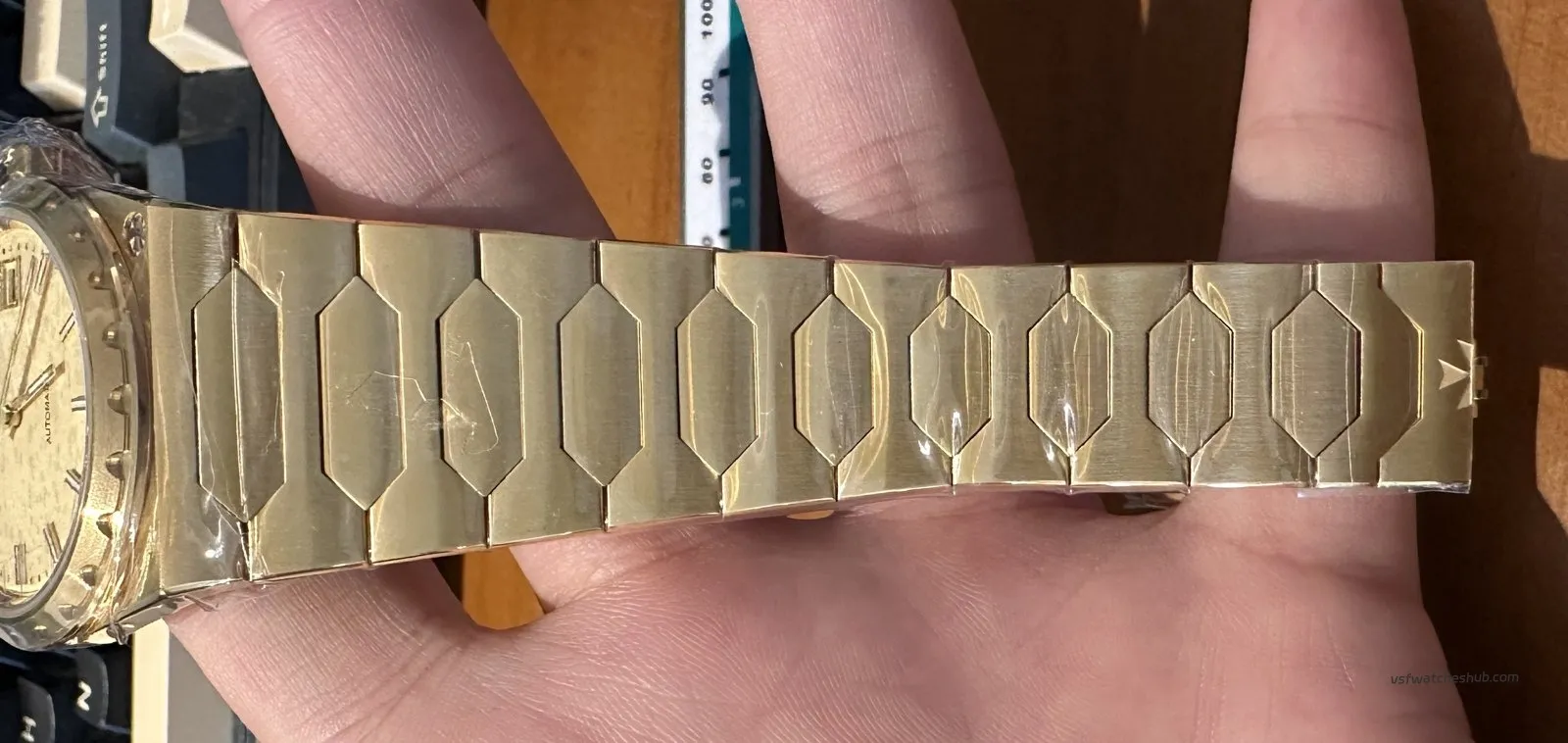
Laid flat, the bracelet has 18 links. I didn’t remove any for this review, so the 123 g on the scale is with the full bracelet.
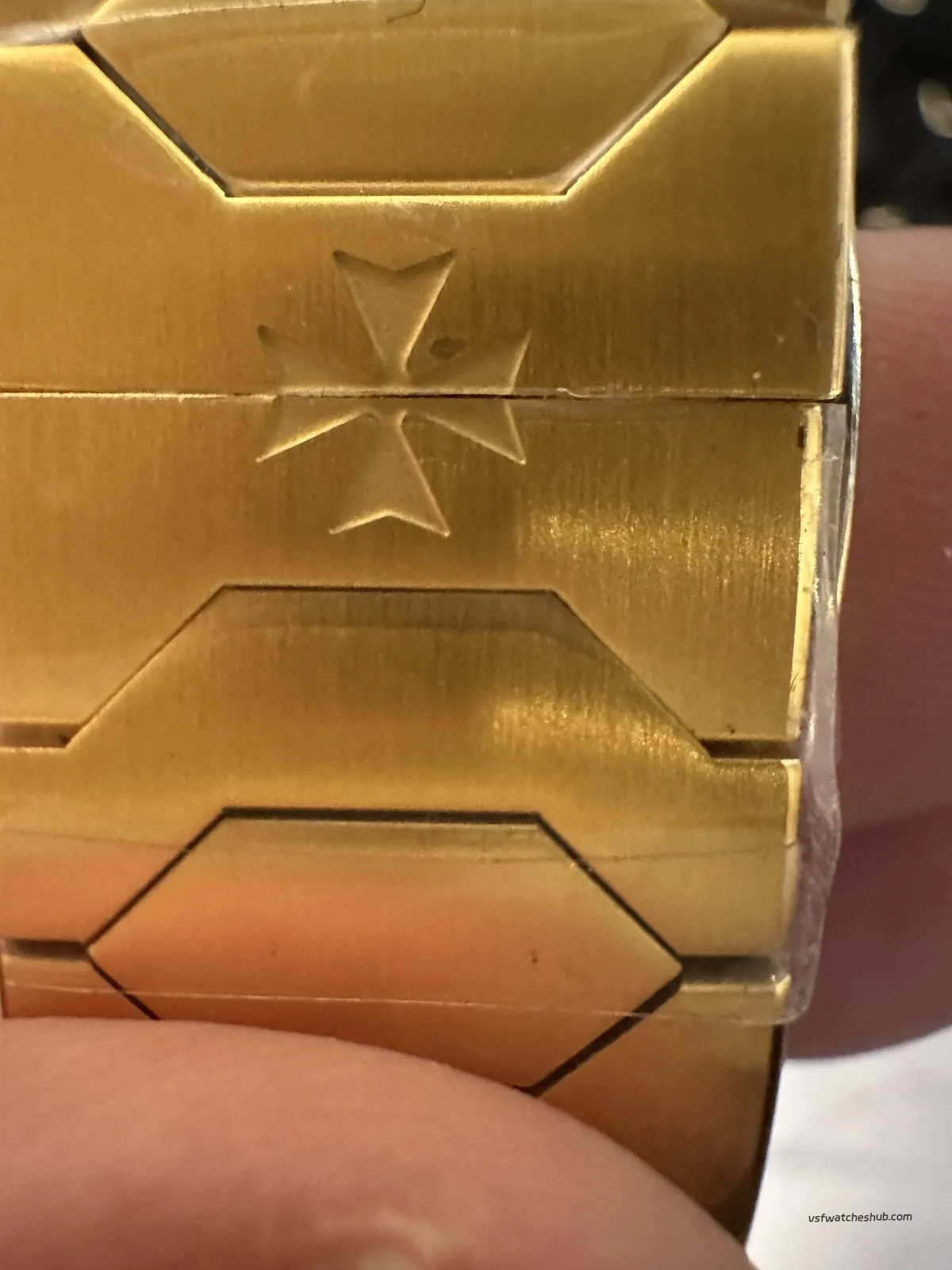
The Maltese cross on the clasp cover is crisply cut and sits centered across the two halves.
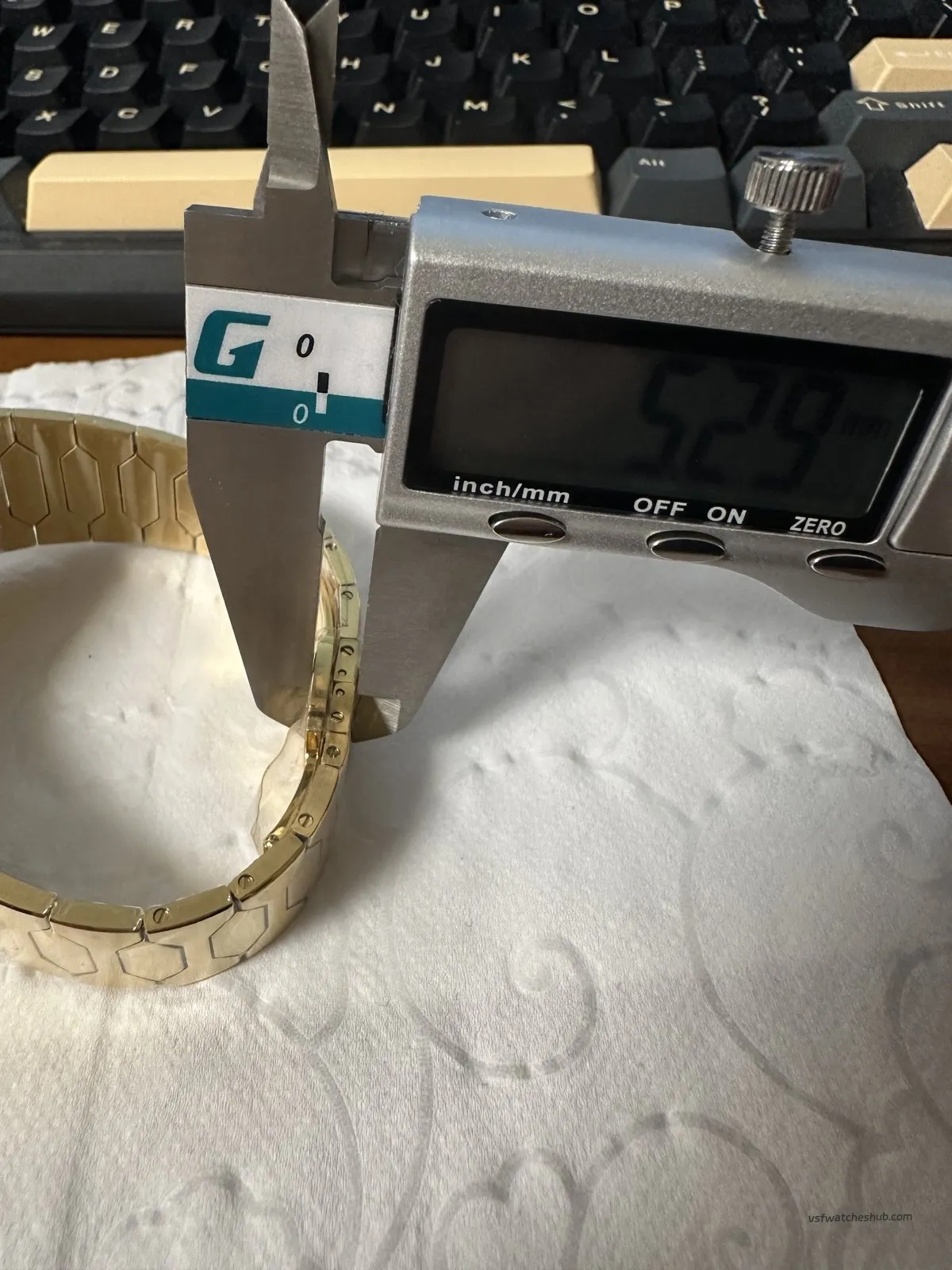
The clasp measures 5.29 mm thick, so it doesn’t add much bulk under the wrist.
Codes and stamps inside the clasp
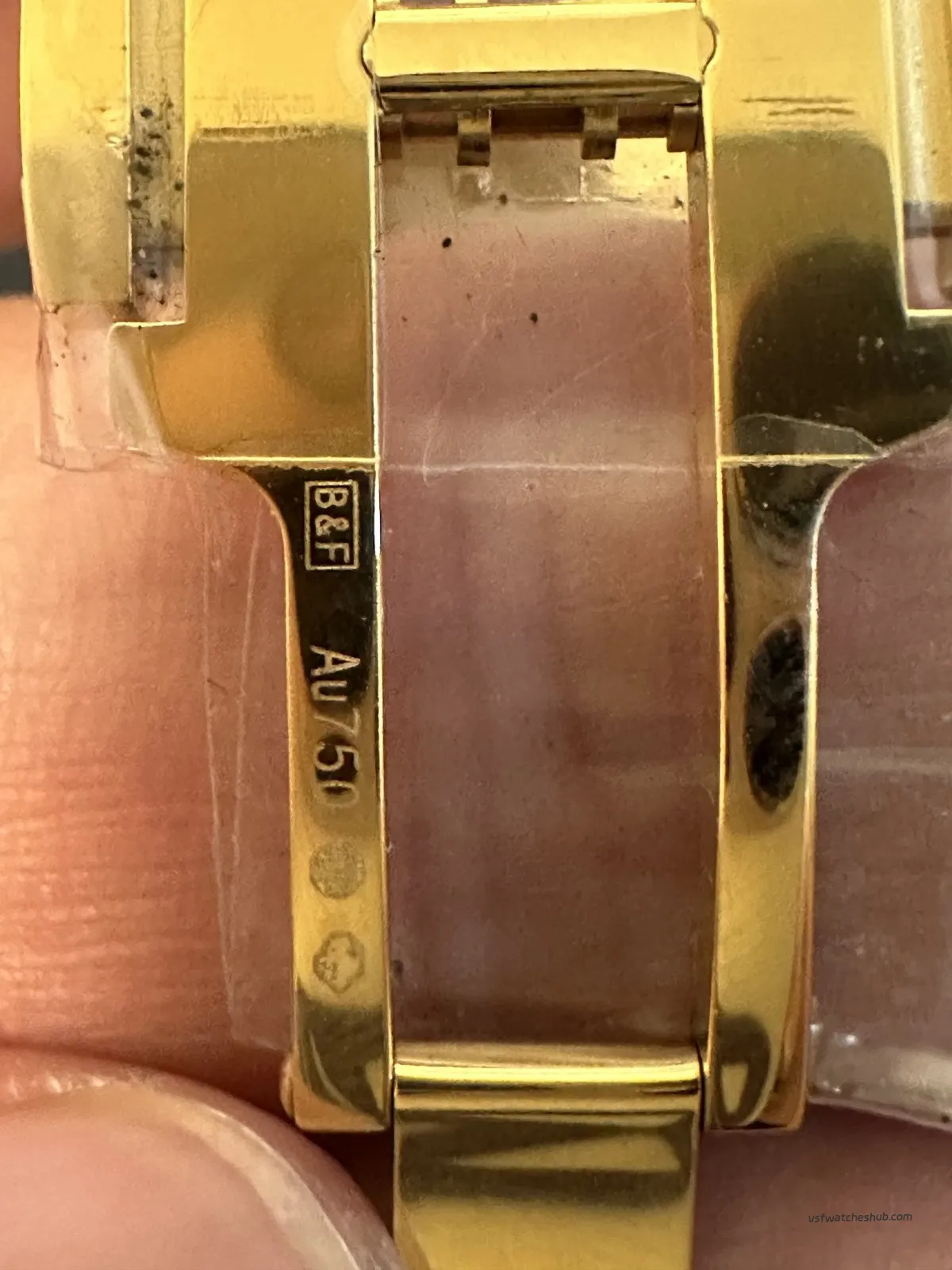
This is the part most buyers never look at, and PPF clearly did. Open the clasp and one side carries a B&F maker’s mark, Au750 and hallmark-style stamps.
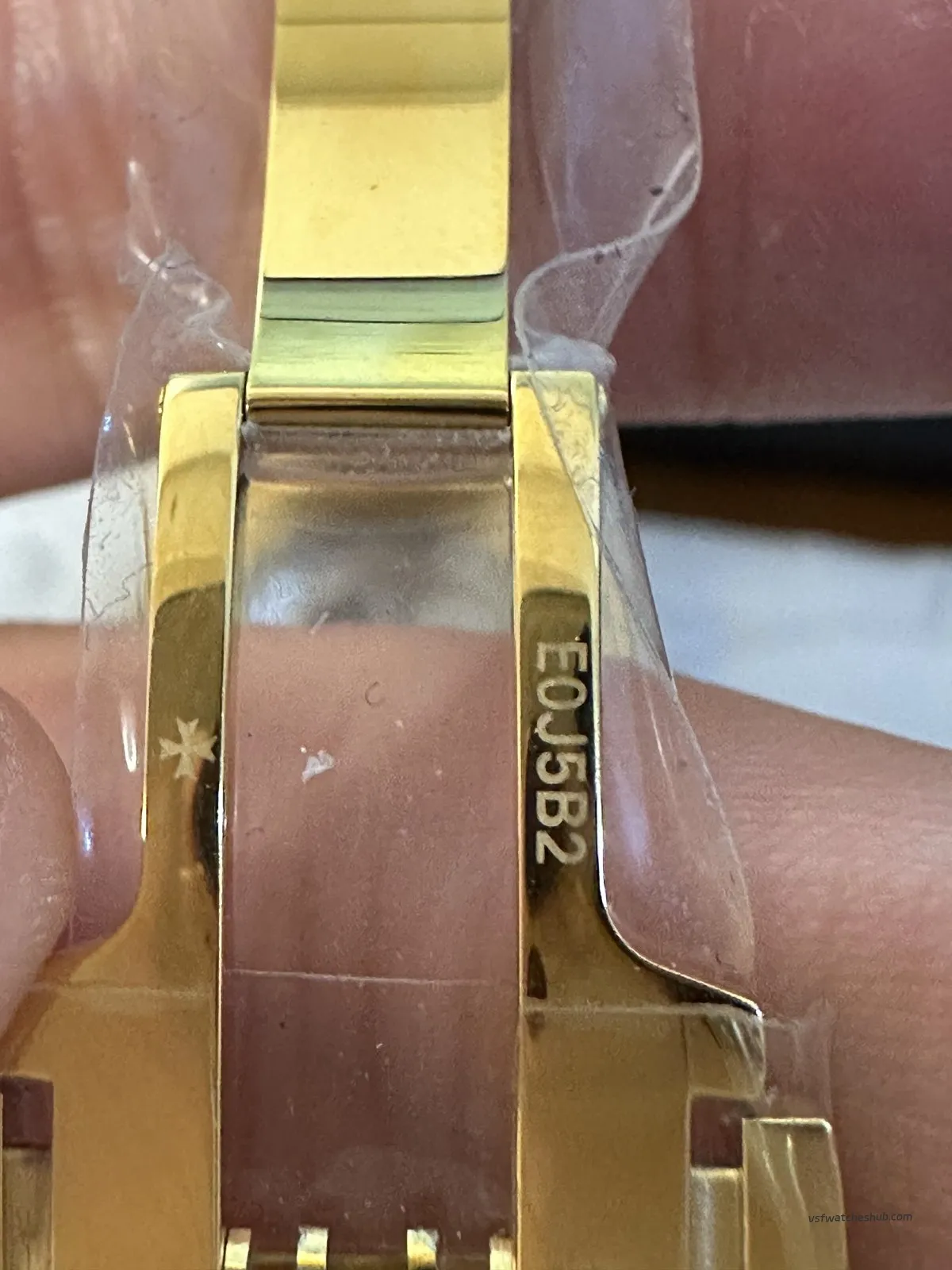
The other side has a small Maltese cross and the code E0J5B2.
The deployant carries another code, EXBK, and the inner links near the case are engraved too.
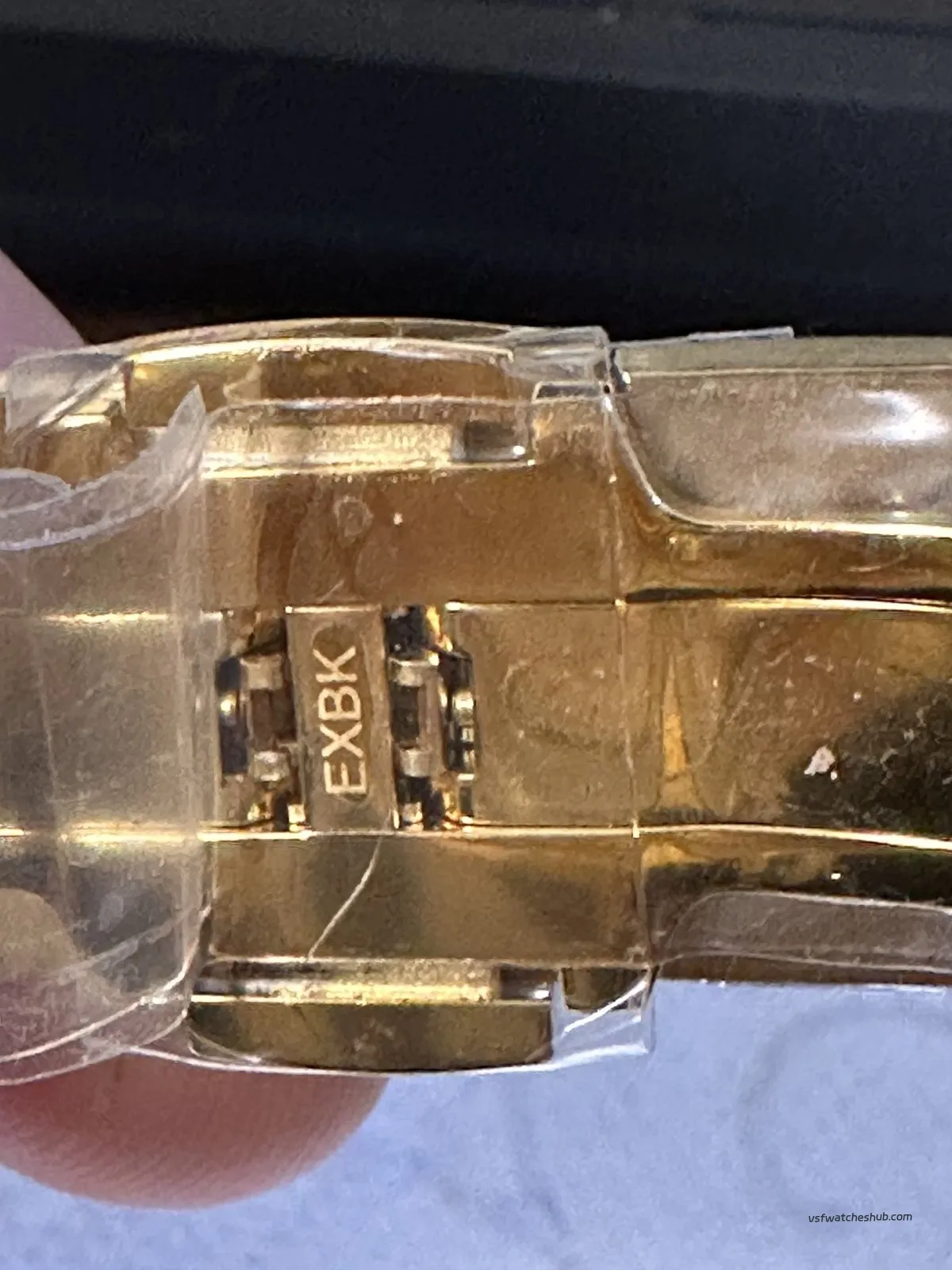
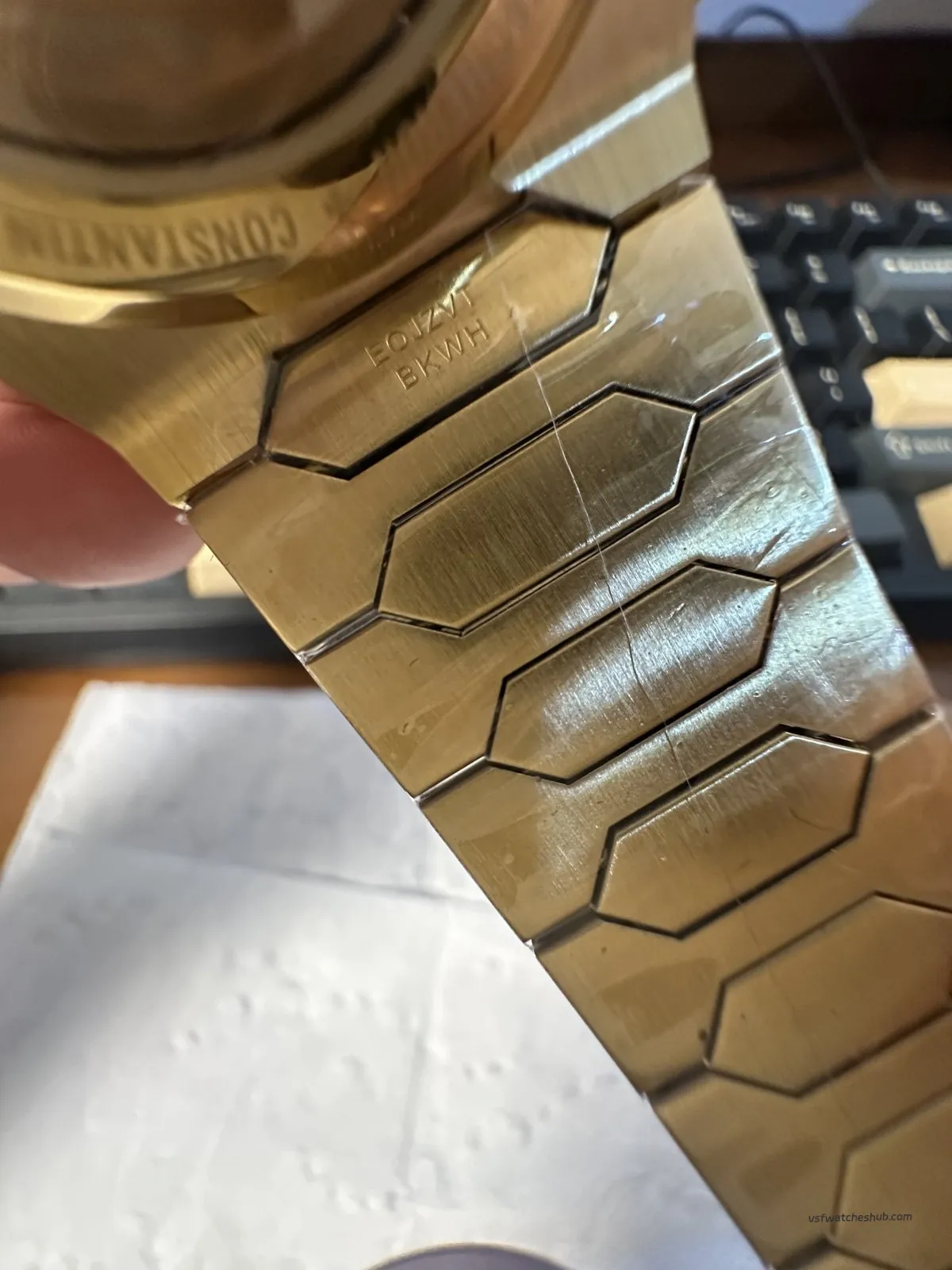
All of it is sharp and evenly engraved. Just don’t read the gold marks as gold. Au750 means 18k on a genuine piece, and this bracelet is plated steel.
Movement
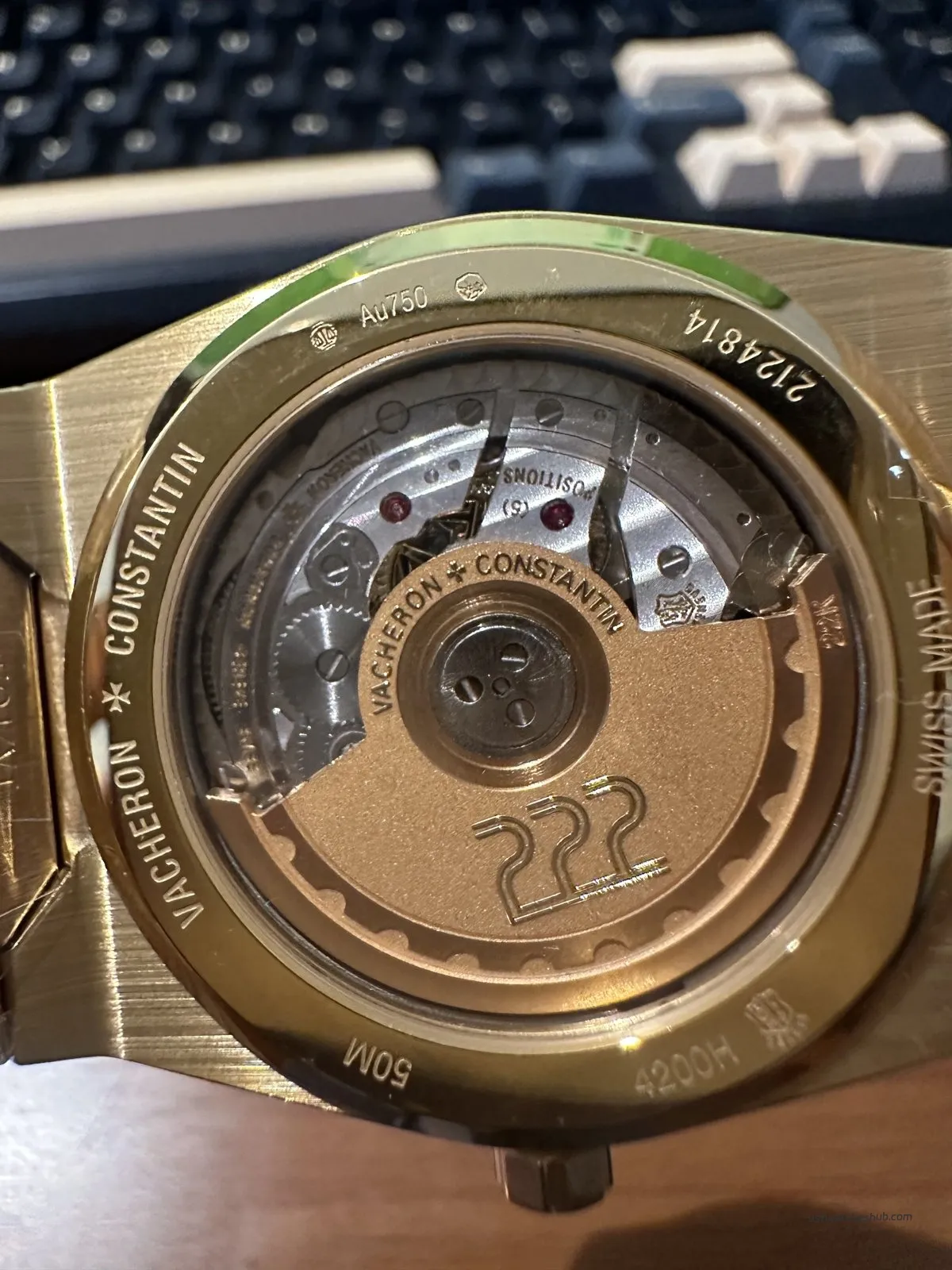
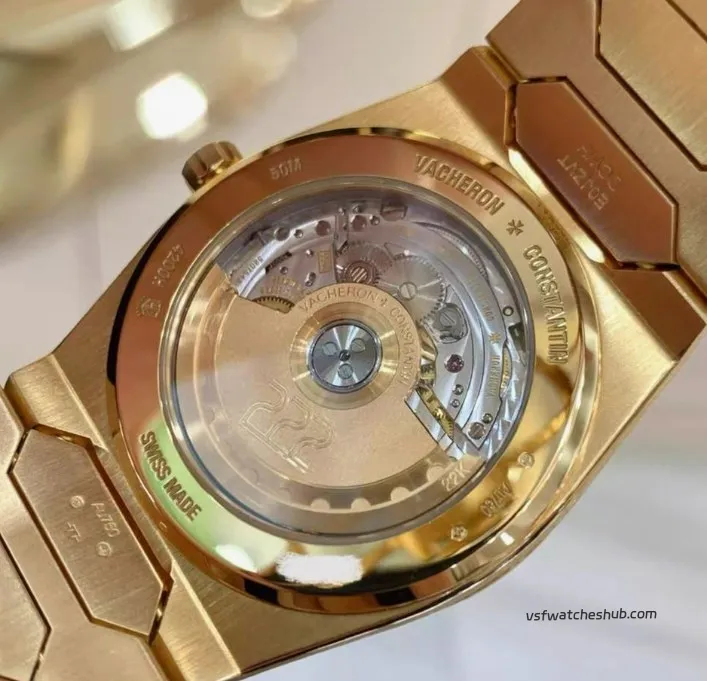
Through the sapphire caseback you get a gold-tone rotor with the 222 engraving, and at a glance it looks like the photos of Calibre 2455/2. Look closer and the structure and finishing materials are clearly different. If the open caseback is a big part of why you want a 222, know that this is where it’s least convincing.
For comparison, here’s the caseback of a genuine 4200H/222J-B935. This photo is the real watch, not ours. Put it next to the shot above and look at the bridges, the finishing and the rotor, which on the genuine is solid 22k gold and stamped 22K.
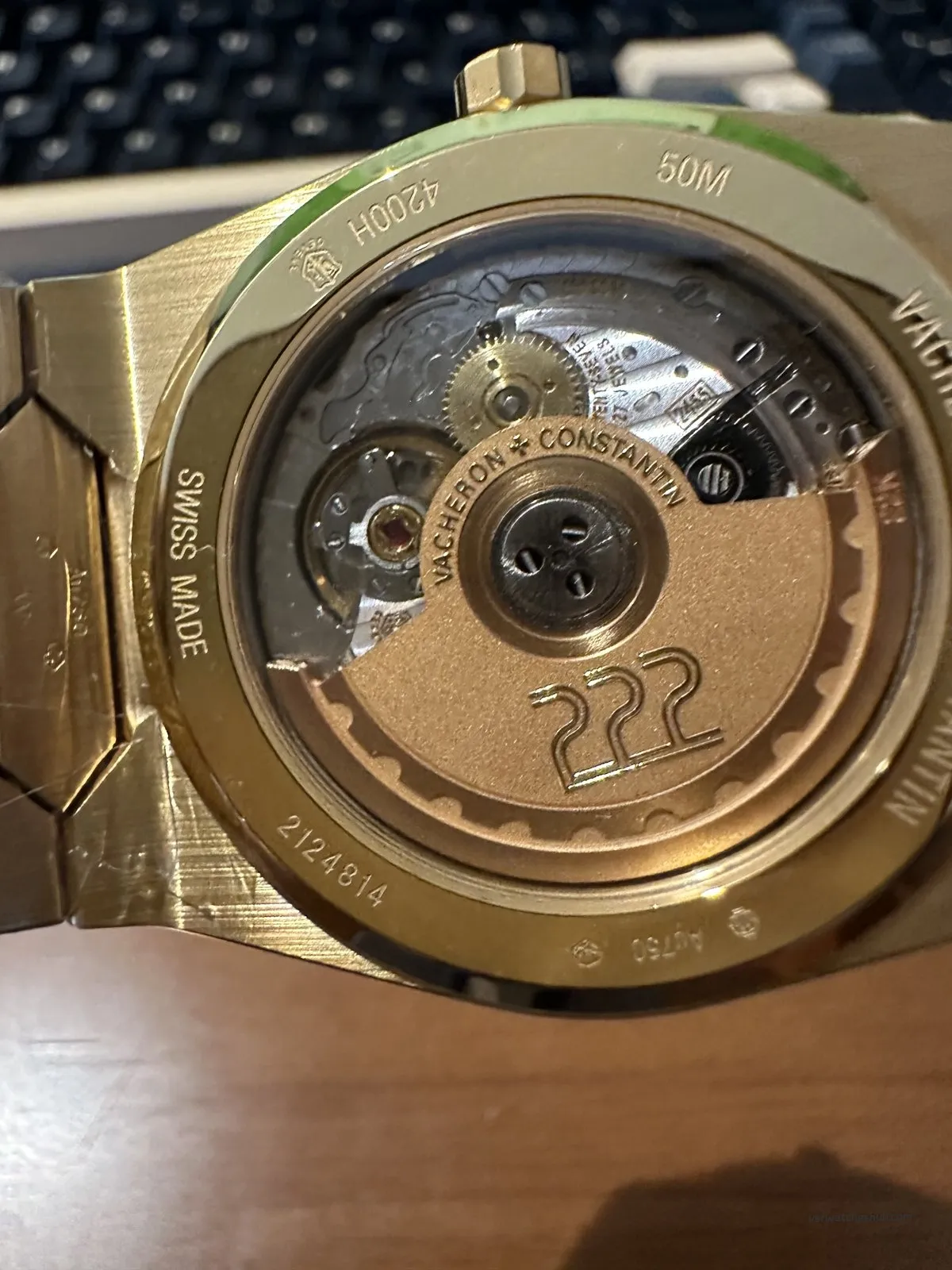
The caseback ring is engraved with 4200H, 50M, SWISS MADE, a serial number and Au750, and the lettering is clean. Same caution as the clasp: the 50M engraving doesn’t make this watch water resistant, so keep it out of the water.
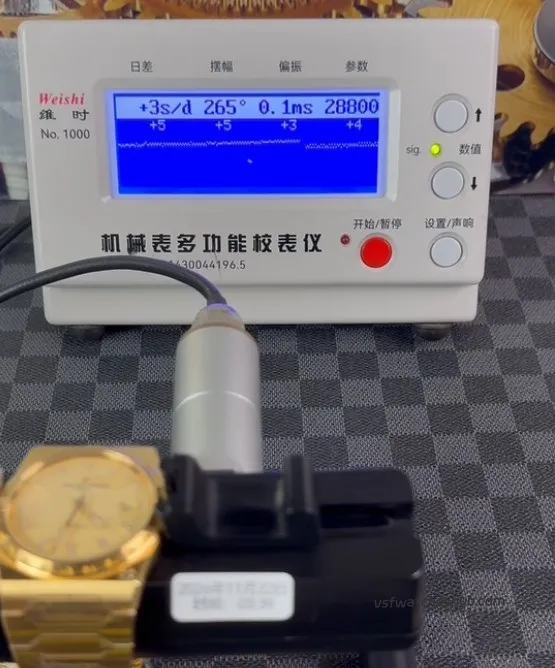
On the timegrapher, dial up, it ran +3 s/day at 265° amplitude with 0.1 ms beat error and 28,800 vph, the same beat rate as the genuine. That’s a single dial-up reading, so treat it as a first check rather than a full multi-position regulation report.
The other thing you should know: shake it hard and you’ll hear the movement. That’s common with the ultra-thin movements used in thin replicas. With normal arm movement during the try-on I didn’t hear it.
This is what it sounds like when you shake it hard. Turn the sound on.
On the wrist
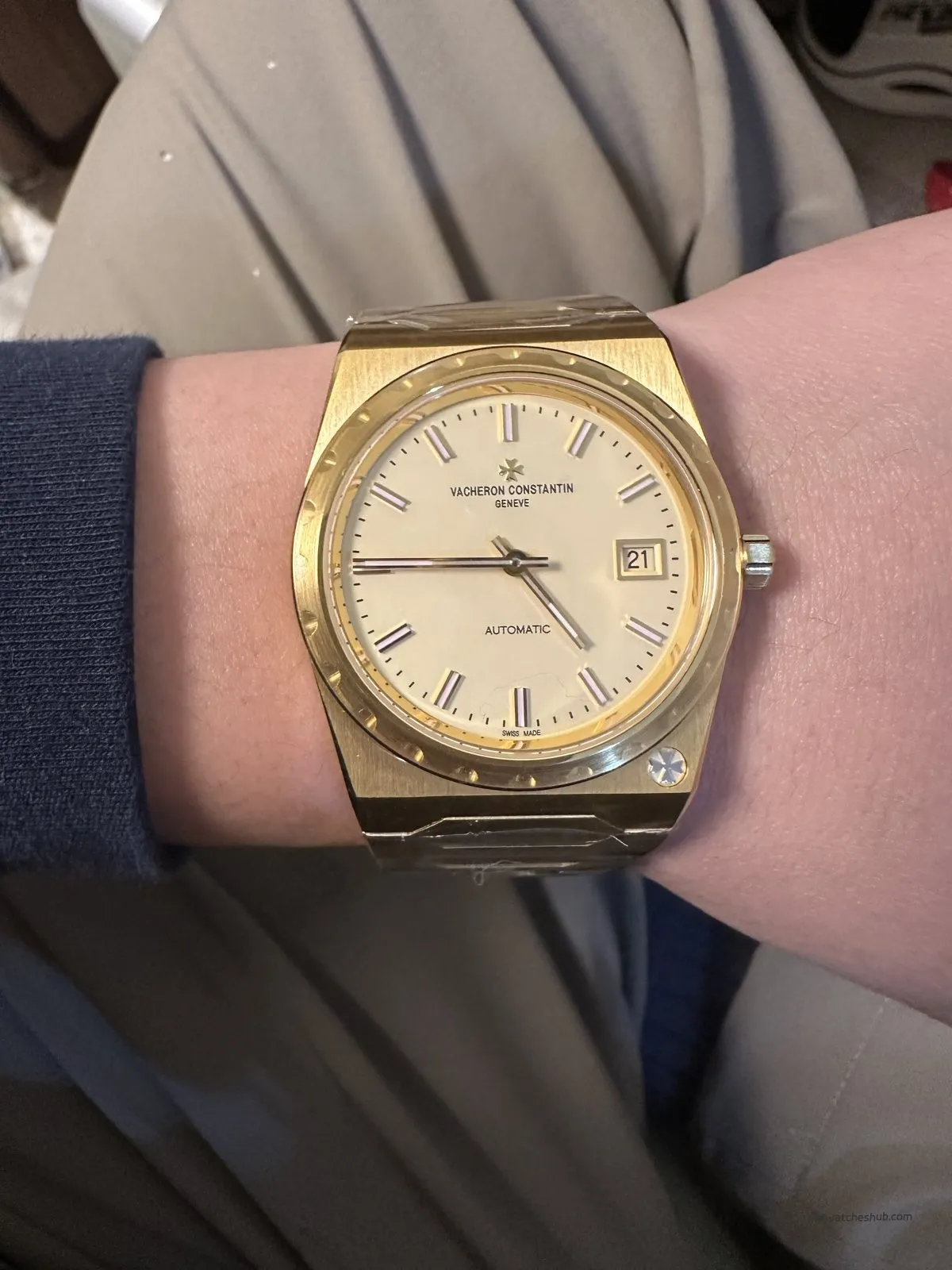
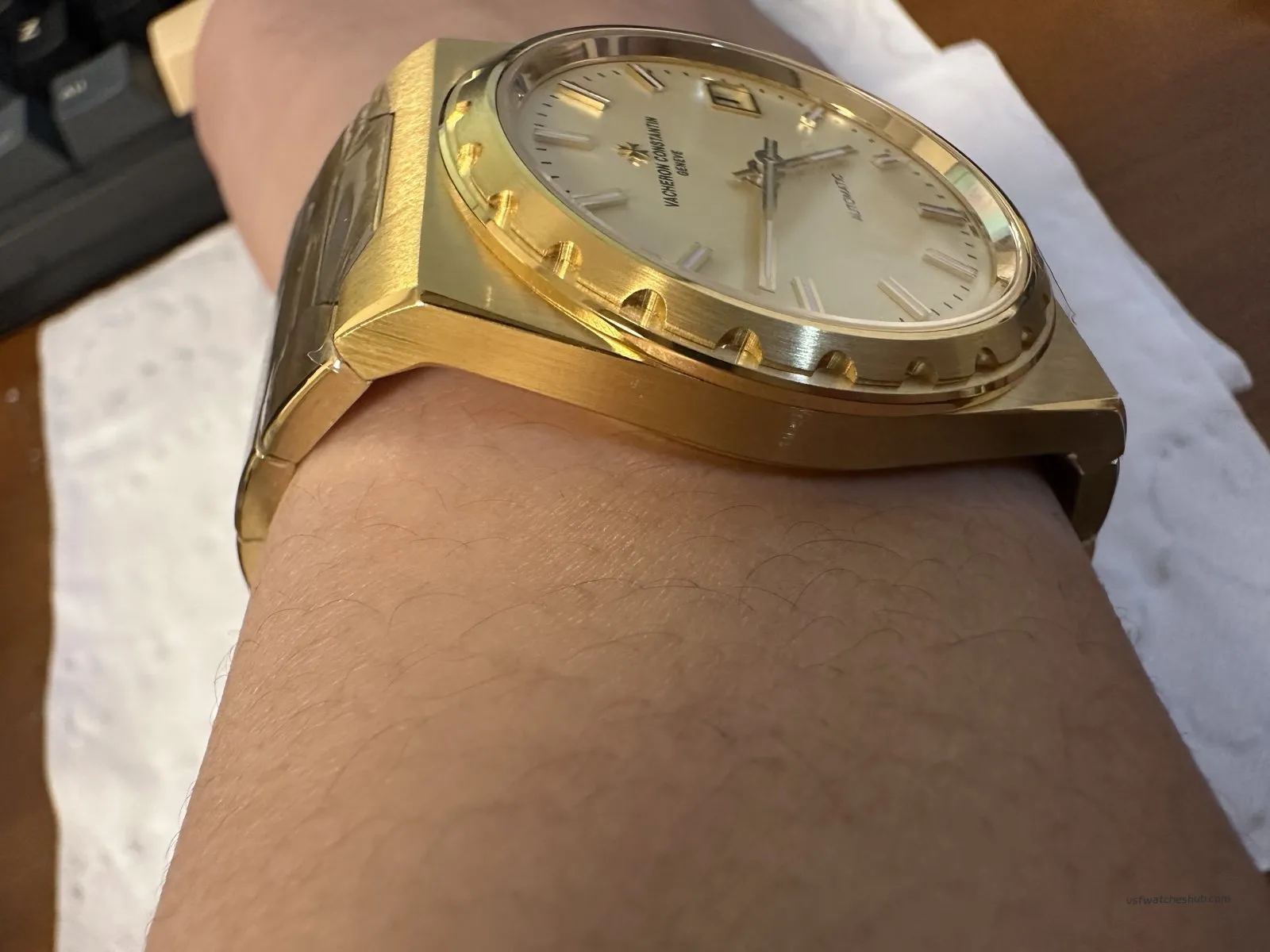
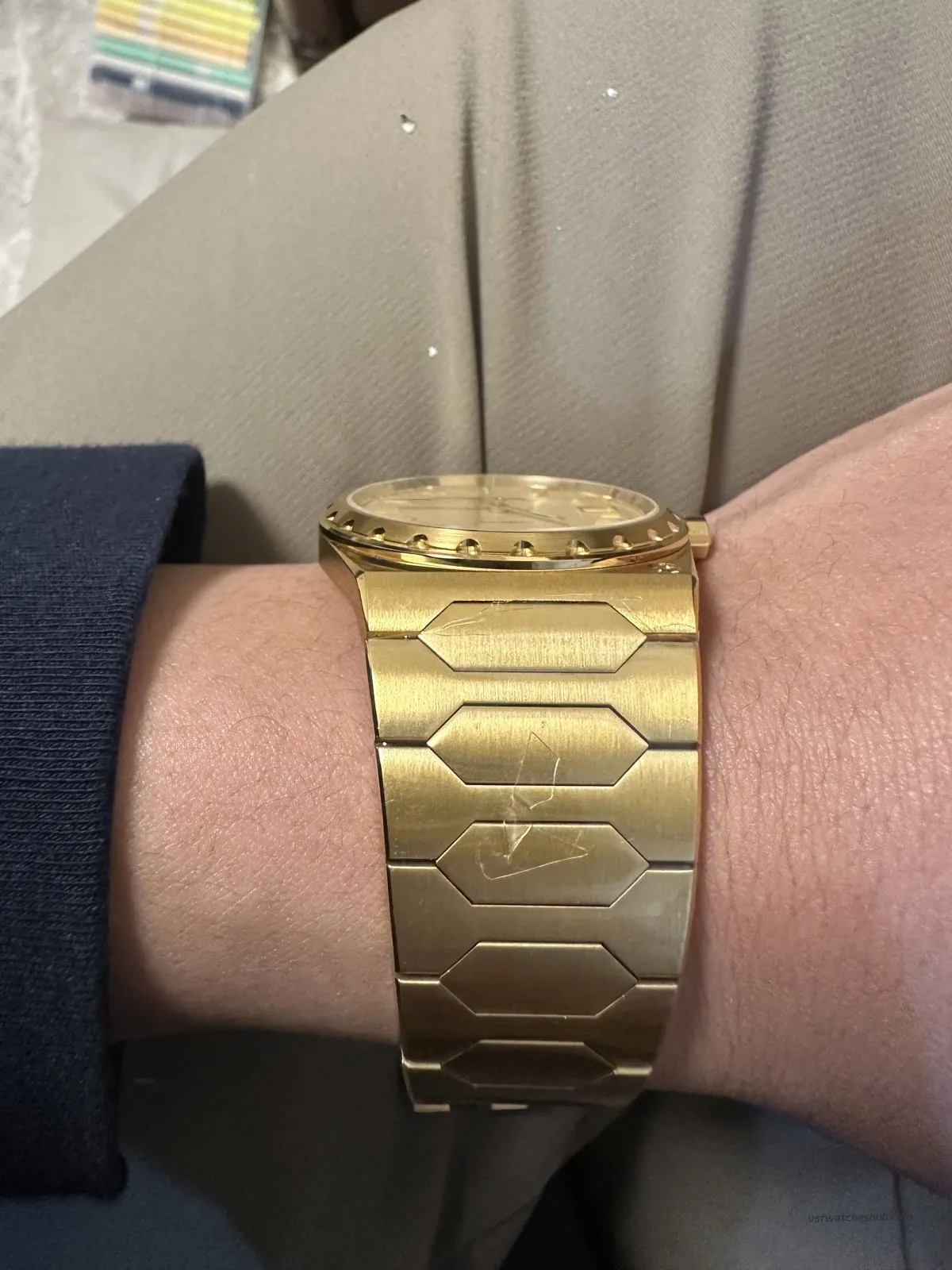
37 mm sounds small, but the integrated case and wide bracelet attachment make it wear bigger than the number. It hugs the wrist well. I’d say it looks best from about a 17 cm (6.7 in) wrist up. On smaller wrists the case shoulders start to take over.
If I could change one thing it would be the weight. Something around 150 g would feel more like what people expect from a gold watch, but with steel under the plating that just isn’t realistic.
Our scores
| Area | Score | Why |
|---|---|---|
| Case | 8/10 | Brushing softer than the genuine |
| Dial | 9/10 | No defects found under magnification |
| Hands | 8/10 | Lume fill slightly uneven at macro level |
| Bezel | 9/10 | Notches cleanly cut and brushed |
| Date | 8/10 | Fine at normal distance |
| Crown | 6/10 | Works well, feels ordinary |
| Bracelet and clasp | 7/10 | Stiff at first, cover edges not perfectly flush |
| Movement | 6/10 | Right at a glance, different up close |
| Comfort | 9/10 | Best on 17 cm+ wrists |
| Total | 70/90 |
Is it worth it?
Let’s be honest about the math. The yellow gold 222 launched at $62,500 in 2022, and new ones are listed around $74,000 now. This one costs well under $1,000. If you want something that holds value like the gold original, this isn’t it, and nobody should tell you otherwise.
If you want the look for dinners, nights out and everyday wear, it’s very good value, as long as you accept the two compromises: a bit of movement noise when you shake it, and a weight that tells you it isn’t solid gold. My own take? Keep the money for the sports car. Once you’re stepping out of one, nobody is checking your watch.
The watch in this review is the 222 yellow gold we carry. If you want a specific angle photographed before you order, message us.